Friday started with me waking early and not being able to get back to sleep. I rose around 6 a.m., with the sun already bright and burning hot—another desert morning. While I had finished the bananas, I did have canned peaches, but I never got to them. I had a day-old croissant from a bakery in Hillsboro that rivaled other local bakeries–excellent. I did my usual items of reading the news (mostly political), updated Quicken with the latest, and started a blog for the previous day. For the Friday blog, I would be surprised to find only 600+ words for the blog instead of my 1,000+ for the last couple of days.
I wrote and was soon done, and it was about 8. I cleaned up (enjoying Henry’s shaving stuff–Thanks Steve, for getting me started down this path–recommended), dressed, and collected my summer hat, iPhone, inhaler, eyedrops, eye protection, wallet, and car keys. Having Air Volvo stop before it left the driveway to get my hat. Traffic was light to Quatama MAX station. Air Volvo arrived without issue and was parked in a nearly empty parking lot on a working day (though Friday is often a work-from-home day). Before the pandemic, the lot was nearly full on work days. It is 9ish, and the trains are running less often than I remember before the pandemic, and the one I take is never close to full. Nobody stands unless they want to.
I used the Hop app to pay for the trip. I had to open the app, and then my phone logged my usage and charged my virtual card $2.20 for the trip. I had to fill this virtual MAX card with money on my previous trip.
I return to 1946 Maisie Dobbs’s stories on my phone’s Kindle app. Time passes quickly, and soon, I am at MAX’s library stop in Portland, exiting the car. I take the park blocks to the Portland Art Museum (PAT). Much of the park blocks are parks, as you would expect. But Portland lost focus on trying to extend the parks of Park Street and allowed a few new hotels to be built on the park blocks; one park, all stonework and with a fountain and pool, is the top of a massive underground and insanely deep parking structure. I parked in the bottom a few times on a lark and can attest the still air and cold are cave-like and slightly disturbing. I called it Vampire Parking.
I walk up the slight hill to PAT, deciding not to overpay for my lunch this time at South Park as I walk by the restaurant and bar. The parks return to Park Street and are filled with elements from a time of statues and water fountains. (A hundred years ago, a wealthy man paid to install temperance-support water fountains and drinking fountains all over Portland.) Now, the fountains are sealed and damaged. All the statues I saw were only as bases; Lincoln standing and Teddy Roosevelt on horseback are gone. Maybe someday they will return.
There was a line to get into PAT, and I joined the queue. One in ten are masked, and most are older (though I resembled that remark). Most are here to see the French Impressionist show like me. I will soon show my PAT membership card, and I am supplied with an official ticket for no charge. I climb the stairs (no elevators for me now) to the second floor of the old museum (I see a dedication stone with the date 1939). It is a small show with a few examples of each great master, and some of the works are not in the usual form I am used to for the artist. The show covers the start of the impressionist movement, savaged by the neo-classical critics of the late 1800s, and ends with the end of WW2 with some works painted in the USA during the Second World War.

Most of the paintings, statues, and bronze works are borrowed, and it appears to be a traveling show. Some of the works are great, but the exclusiveness to only French artists means that other great works are missing. However, I enjoyed the French works once I got over the loss of the important Dutch and German works from the same period. In thirty minutes, again, it was not a large show, and I found myself having seen everything. I returned and looked at Monet and was startled by Renoir’s works, which looked like nothing I had seen before (more Van Gough’s last works than Renoir’s). I could have spent more time, but I enjoyed my brief tour, and my mind runs very fast when I am alone. Time slows.
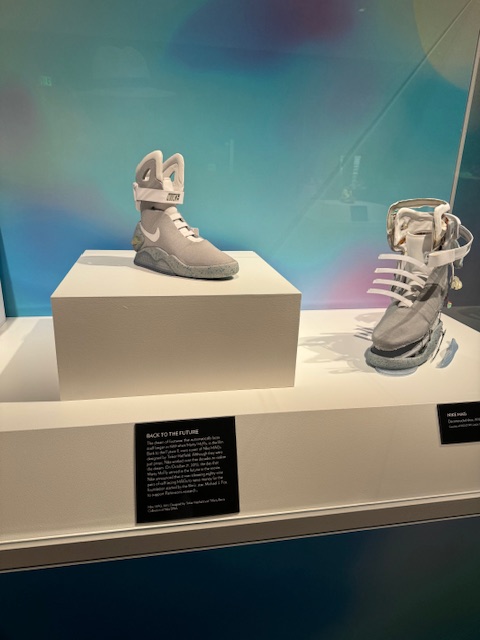
I walked through the other exhibit, Future is Now, which is about sneakers–something I know much about. It reminded me of the Department of Archives for Nike (DNA) and many things I have seen at the shoe company. They had a pair of the famous self-tightening boots made for the anniversary of the movie Back to the Future. Someone had disassembled one boot and made a display of how the shoe was made. My connection to this was the stories from friends who worked for Nike about trying to buy and import motors and the requirements for importing shoes with motors and batteries–no simple task, I learned. I smiled and took a picture.
I found a few cards and a gift for Matt V’s birthday (recently passed). I resisted the showbook with pictures and stories of the impressionist works. I bought a few of these books from wonderful shows and then discovered that I had never opened the cover. I saw the scarves and jewelry and, as usual, thought of getting something for Susie; she would love that—I would think. It no longer makes me sad as I remember Susie while at the museum. We did so many together.
I am done, and it is not even time for an early lunch. Portland seems still sleepy on the bright Friday morning. I walk down Park, not sure where to go, and soon discover a few shops that I had heard of and meant to visit, but they are gone and for rent. The end of the pandemic brought an end to those payments (to churches, too) that kept everything working, and many businesses found the changes post-pandemic voided their business model. As always, change or die is how the American economy works–there is no right that your business will survive. Portland was hit hard after the pandemic, and many businesses just raised prices and cut service, attempting to survive on out-of-date expectations. Those places are now available to rent, cheap.
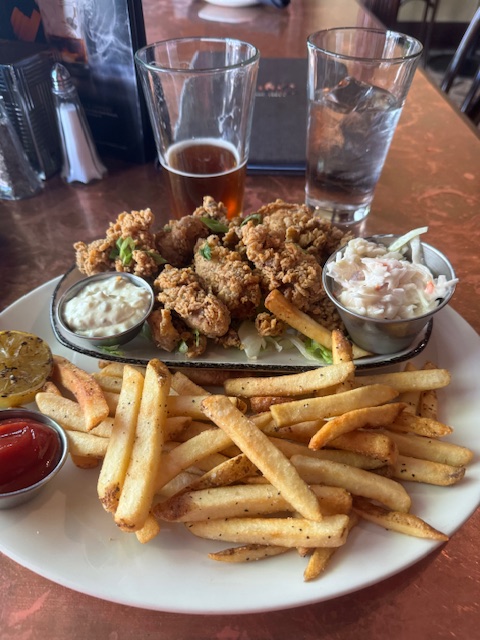
I remember where I was, left Park, and found Jake’s Grill. I have not been here for a while. I get a table with a window in the bar. This means no white tablecloth and no waiter. Instead, I get Tucker, the bartender, and a copper-topped table. Tucker picked a good ale for me, and we agreed that summer is a time for oysters and not the chili blue plate special. The Oysters are $19, which is a bit steep for lunch, but this is Portland, and I am getting used to the higher prices. Like I get in other places, I expect three or four small oysters lightly breaded and fried in a pan. I get well-breaded and deep-fried, like their fish and chips, six huge local oysters. Each is cooked to perfection. The fries are cooked perfectly and called out for vinger (instead, I use ketchup), and the cup of slaw is good and not too much. I am challenged to eat this much food.
Oysters and I are not on good terms. I love them, cooked and breaded, but I find them difficult to enjoy later. I paid the bill and headed home. At the MAX station, I read for a while and realized something was wrong. I notice a gal dressed like she is going for a shoot for Vogue; she is striking, and she seems to know what is going on, so I ask her. Willing to address a lesser mortal (I asked politely), she informs me one of the trains hit something. We wait, and in thirty minutes, the trains are running again. I skipped the first overloaded train that was only going as far as Beaverton and boarded the next Blue-line train to Hillsboro.
While waiting and sitting in the AC’s MAX car, the Oysters want to make a reappearance, but I resist. I reflect that this is the proper punishment for overeating and eating something as questionable as locally harvested oysters (some of the local oysters are under a ban; they can kill you–large oysters like had are not under the ban). Someone is vocalizing all their thoughts on the MAX train with some volume. I first thought it was the driver explaining the delay, but it was one of my fellow travelers. The speaker, not violent or profane, is politely ignored by the overly polite Greater Portland travelers, as usual.
I arrive at the still empty parking lot without misadventure or re-experiencing the oysters and board Air Volvo. I arrive at the Volvo Cave, rest a while, and finish the last book of Maisie Dobbs, number 16. I cry as I will miss these stories and all the characters the author, Jacqueline Winspear, created and the reader falls in love with. The story recovers the life of the main character, Maisie or Mrs. Scott, as she is also known, and suddenly ends the book. I liked it and think it is one of Winspears best books. While I recommend the series, some books are dark and hard, and there is a water gypsy story I wish Maisie had returned to; I like Chief Inspector Gamache Mysteries better by Louise Penny. I can hardly put either down when I start, so it is only a small difference. All are recommended, but Maisie Dobbs’s books should be read in order.
Drying my tears, I made chicken noodle soup for dinner. I did laundry and the dishes and considered something to do. I decided to return to my Sherlock and Watson story, but I was tired of the house and headed to Barnes and Noble to write there. I arrived, and my sister called. I have to talk to Mom Wild; these details cannot be shared here.
I returned home after making a few changes to my story, and I am now a bit worn out by the events. I vacuumed the house in the dark. The air outside smelled of smoke, and before sunset, the sky changed from deep blue to gray-blue—forest fire smoke. I strip the bed and wash the sheets, towels, and things that missed the first wash.
I cut the donation checks for the church. A pile of money to pay for an automatic door for the front door and another pile of money to fix up the entrance and the sanctuary. Since I agreed to help, all the costs have increased. Time to get out while I am behind! I write letters, transfer money, and update Quicken with all the changes. Some of the changes are in Susie’s memory. I include her picture in the letter. I emailed copies of the letters to various involved folks; I will drop off all the checks and signed letters on Sunday, so they will go in this week’s deposit–I was the treasurer and know all of this.
I made the bed, shower, and started a new book. The Caliph’s House: A Year in Casablanca by Tahir Shah has started out well, and the pages seem to fly by. I bought the physical book at Powell’s used—trade paperback. The print is large enough, and the larger softcover book is light enough that my wrist is not complaining the following morning.
While not late, I hear Pink Floyd finishing Darkside of the Moon (I have been listening to it often), and I change to sleeping music. I soon drift off and do not wake until the sunrise. Thanks for reading.

 Alohawild (Michael Wild's) Website