Going backward, I was home about 11 from Portland. There, I did my usual Saturday night gaming at Richard’s place, but this time, we played board games that I had brought. We had three players, me, Richard, and Chris. Chris and Richard are hard to beat as they get games fast. Richard had watched videos on how-to-play and had one video ready on an iPad to help with questions.
We tried for the first time the new game from Worthington Published, a favorite game maker, Crises: 1914. This is a game of brinksmanship closer to Twilight Struggle than the usual Euro stuff we play. Richard was worried it was another Pax game; we have not loved these strange political negotiation games. Instead, it is a non-intuitive card game with complex constraints, many of which are not apparent to us until we play a few turns. We played with three players: Russia, Austria-Hungary, and Germany. This is pre-WW1, meaning all of these are imperial countries, and the cards describe events many I have not heard of (there is a separate book that describes each one and even footnoted sources). Chris thought more text should be on the cards to make you feel more connected.
Playing Russia, Richard ran a highly aggressive first turn and soon had his tension markers moved up, but scored high on the first round (a week of the original crisis timeline). Chris (Austria-Hungary) was close behind him, raising his tension. I was at the bottom. Germany, which I had not played in my practices, had many weak cards and was confused during the first week (the game simulated the crisis, and Germany was quite messy during these first weeks).
Chris soon had plenty of cards and began, on the second round, starting to catch Richard. Richard pointed out that Chris had interesting cards as the game simulates his country forcing many issues and events—like the historical crisis. I thought it was fun; as an amateur historian, I enjoyed reconstructing the crisis. Richard played more conservatively, and we checked the rules all the time. The game needs a playing aid describing all the player options, as I constantly reminded Chris and Richard what their play options were. I will make one.
We all started to grasp the game about the third week. Chris started the beginning of WWI by playing the Ultimatum (which, when played early, gives him more victory points), and all of us got a War card. I was behind and began to play aggressively, but soon, I nearly lost by starting WWI!
In the fifth week, I had only three cards in the draw pile, and we learned that all arrow cards are dropped even from your playing hand and reshuffled into the draw pile. I had drawn the War card into my hand, terrible luck, and now had to shuffle the card into my draw pile. I then, as usual, drew three cards to start the turn. F**k. The War card was on the top of my draw pile and was played to start the round. I started the war and lost the game automatically! Richard and Chris fought the last week and played the maximum number of cards, with both having to draw a random card. No War cards, unlike me; they survived to the final scoring. Richard beat Chris by one point and turned down Chris’s offer for a peace conference (and thus giving Chris the game). Richard enjoyed yelling, “There will be no peace in our time.” The wrong war, but it still seemed to fit.
Crisis: 1914 is a game for history lovers. I thought playing brinksmanship was exciting and intense, a new game experience for me. Once you understand this game, it is a function of luck and pushing maybe too far. I think the rules are not bad, but it is hard to play without a player’s aid, which must be fixed to play again. Richard thought it was a faster and more manageable version of Twilight Struggle, not dull or strange like a Pax game. I see us playing the game again.
Next, we played Unsettled, a cooperative game designed here in the Greater Portland area. We played the same planet as before, the second one with the initial game: 002 Grakkis. This sci-fi game simulates a group of scientists forced to explore a planet, Grakkis, find resources, and perform tasks to escape the planet without dying. It is cooperative and allows you to play certain science discoveries on your own turn, constantly making the game a debate about who is doing what and not burning down resources too fast. The motto of the game is “Space is dangerous; try not to die!”
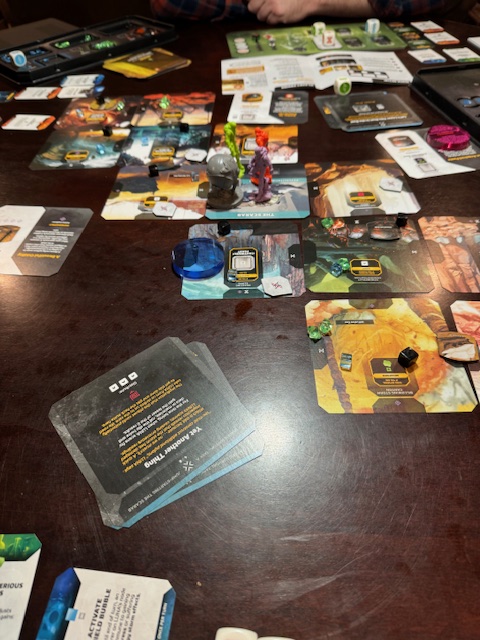
(Just as we escape and survive in Unsettled)
We all enjoyed the three-person play, and Richard and I knew enough about this challenge, A, to make it work. We all survived and enjoyed the game. We must try ‘B’ or even do another ‘B’ on the first planet, 001 Wenora. I have six (maybe more) planets to try.
Before this, I decided to get some walking in and writing done. I need a 500-word horror story for the H.P. Lovecraft Film Festival PDX micro-fiction contest. Thus, I am headed to Barnes and Noble for a cookie and coffee and will spend the mid- to late afternoon writing this story. I had an idea about silver and mirrors, but I could not complete something in the three hours of writing. I deleted much of what I wrote (a consequence of the 500-word limit). I walked the strip mall to get some steps in (only 3,000+ for today) and enjoyed opening a Halloween mega-store with substantial scary displays (though I did not see how to buy one). One was a spider that jumped. The trigger is on the floor, but there is a delay, so it jumps after you are sure it is not working or tripped, which scares you. It made me jump three times. Even knowing the timing change did not help; it still scared me!
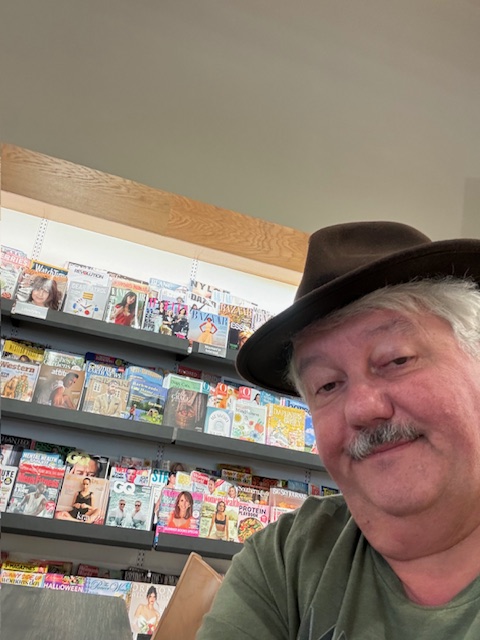
(I am sitting with all the lovely people on the covers. None of them moved, I think)
Here is a preview (still with typos of what I am trying):
Early in my life, I learned chemistry, focusing on metallurgy. I read, learned, and practiced. I updated the alchemists’ ways, which I found in the old text, with the most secret text now available online. I avoid mercury poisoning and many inconvenient deaths as I practice these ancient and dangerous mixtures, but now with perfect execution and safety, using silver, not cinnabar, and clean, pure materials.
In my lab, the fumes from my test tubes dance like fairies, but don’t be fooled—deadly. A face twisted and angry appears through the glass in boiling liquids and fades away; a momentary golem. Colors burn in my fires I have never seen nor can describe being somehow all and none of our worldly colors. I combine silver, arcane chants, and pure chemicals at temperatures and pressures unreachable by long-ago alchemists.
I am Alchemist 2.0!
Returning to chemistry, I dissolved my special, unworldly silver ally metal into a mist and applied it to glass. The mirrors provided a view into the true world. I learned that our world often avoids conflicting with the true world, and structures that conflicted seemed to age, be haunted, or failed in unexpected ways. There is a true feng shui to our world but based on avoiding conflict with the true world.
There are many terrible metal creatures and soon I see them often in the mirror. They seem to notice me. Somehow my viewing creates a connection to the true world and the awful reforming things move towards me. Later, I notice that my lab coat has tiny burn marks. While I see them, they can see me! They can just reach me, if I am careless.
I decided to try Mod Pizza again. Mistake. $25 and very average pizza. Not recommended. I seldom call out food joints, but this one was expensive and corporate. Ugh!
Before this, I was home, wrote the blog after rising later, and did some work on SMS Derfflinger 1916. My lunch was leftover pasta and a pork chop.
I am skipping a few boiler plates and just covering interesting things today. I hope, dear reader, you enjoyed my highlights.

 Alohawild (Michael Wild's) Website