Tuesday, the day I write this, is rushed, so this will be just the highlights. I will use lowercase for some things in the game description (i.e., temple mount) as they are represented in the game by a collection of things to avoid confusion with the actual places.
Michael R and I agreed to try the Siege of Jerusalem in 70 AD magazine wargame from their magazine, “Strategy and Tactics” (S&T). S&T, part of the game publisher Decision Games, has been publishing games in their quartile publication for as long as I have played games. They now have two other publications on modern warfare and WW2, complete with wargames. I still have a subscription to their non-game quartile, a unique detailed history of some interesting military subjects I may read cover to cover. An excellent read with all the details from a gamer’s view of battles, events, strategies, and tactics. I never had time to learn and play a new game every quarter; I only buy individual issues with irresistible topics (Putin’s War, the Siege of Jerusalem, for example).
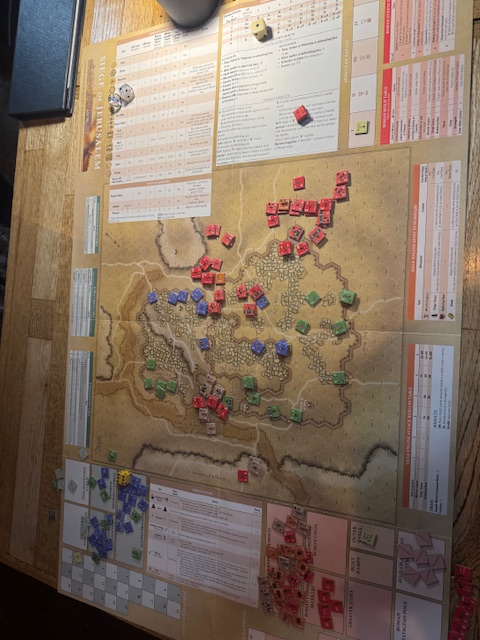
I picked Michael R at 2ish, and we then traveled to The 649. The bartender reminded me of her name (she looks like her sister Avary)–but I forgot it again. Later, she is replaced by Natalia. Michael R. is not a wargame, but we were both biblical scholars and interested in the subject, which gave us the drive to make this work. It took us, feeling much like an old Avalon Hill wargame, a few hours to set up and for me to cover most of the rules. Time, which often happens with a wargame, was ignored and spun the clock fast.
We had a beer each, and I played the Romans. Michael R felt exposed and overwhelmed as the forces the Judaians faced were ridiculous. Michael R learned that walls do not protect you from attack but give you good cover, simulated by shifts on a combat table. This scale makes a Roman legion, five infantry square markers, one leader, and a punched classic square of paper.
Michael R, as the rebels (or Judaians), tried to stop the Romans from breaking into Jerusalem’s New City, and Titus, their leader, joined the battle. Or to take the temple mount with Titus’ son leading that. As in the historical struggle, the Romans were camped on the East and West of the city. There are about four Roman military paper squares for every rebel, which looked scary.
We started, and the first house rule started. We did not roll dice for resources on the first turn but took an average of 7 on two six-sided dice. The first turn was crucial, and the game would lose value if one side rolled terribly and the other rolled well. Later, resouring will be done using the dice. Michael R felt better after he was able to purchase more troops and cover more of Jerusalem. But he saw the Romans build camps and prepare ramps.
The game started with us both drawing events and actions; the game had a random draw of command counters that drove the phases, and there were six for each. Michael R was surprised by all the actions in one month of simulated time. Both events were to Michael R’s advantage, even the Roman pick. The rebels got to fire first on the Romans (!?) and blooded some Roman legion-supporting archers.
Titus led his horse troops to fire on the rebels on the wall, smashed up the rebels, and reduced the troops available to protect the walls. The game system has a leader activation system, and leaders provide for shifts in the combat table. The more, the better the attack. The archers and siege weapons also opened long-distant fire, and the 5th Legion moved to attack. Another legion covered the flanks, as did the support cavalry. The rebels could not deflect the attack by hitting the Roman Camp from behind.
Titus’s son also took the 15th Legion and supported forces against a different rebel group in the East. Michael R has two groups of units, blue and green, in the game, but they do not work together and must be activated separately, representing the split command the Jewish revolt created in 70 AD. Using only calvary and not directed by the leader, the attack faltered but split the rebel’s attention. The Romans had enough forces to attack from two sides with cavalry to quickly be ready to exploit any weakness. The extreme pressure the Romans provided shocked Michael R and I, both amateur historians.
Michael R’s counter-attack on the East, the temple mount, failed to dislodge the Romans, and he rushed more troops and his leader there (he was guarding a wall that the Romans did not target). Seeing the rebels busy in the East, the Romans took advantage of the work before and took part in the wall of the New City, which was still undefended, with Titus leading the battle forward. The 12th Legion reached the walls and brought ramps, removing any advantage of the wall and letting the heavy cavalry into the city. The New City was doomed.
The 5th Roman Legion attacked the fortress on the wall for The New City and suffered terrible losses, showing that the attacks were less effective without a Titus, even with ramps. Despite appalling losses (Michael R felt better about that), a much-reduced 5th Legion took the walled fortress intact.
Titus’s son launched an all-out attack on the temple mount, with part of the 15th Legion bringing ramps and enabling allied cavalry to enter. The legion split with heavy troops guarding the flanks and supporting allied forces fighting the battle. With heavy losses to the Roman allies, a toe hold was established, and the gate to the temple mount was held by Roman allied troops! Hazzah!
We were now five hours in. We were about 2/3 through the first month! There are five months. Michael R and I talked about history and how history records the same events while having a delicious meal served by Natalia. I was on a second beer as I celebrated the Roman successes.
Michael R began to abandon The New City, moving troops to the next conflict, the walled Middle City. The defenders of The New City were forced to fight at a significant disadvantage with Titus and his cavalry in the city now. Michael R took sniping shots at the lesser Roman forces and did some damage. One of the rebel leaders was trapped defending (the Zone of Control rules in the game made an encircled unit weaker and unlikely to escape). Leaders cannot be replaced.
The Romans broke out in the city, with Titus leading and attacking and taking the gate to the rest of the city. The advance slowed to mopping up the left-behind units there to slow the Roman advance and prevent Titus from reaching The Middle City before the next turn, allowing Michael R to better defend it (by acquiring more troops). The rebel lead fell.
The Temple was taken, and most of the temple mount was occupied. The 15th Legion was now secure in the city. The rebel leader, Samuel–green, escaped to the Antonia Fortress (where it is believed Jesus was tried and whipped) with some troops. The other rebel leader pulled back to the different sections of the city but left more single troops to cause more mopping up for the Romans.
Thus, the first month ended, and we stopped there. While the Romans may not win, it was implausible that the rebels had a chance. While the temple mount fell early in our version, much matched the historical events. We celebrated making it six hours of play without messing up and starting over, my only real goal. And marveled at the results of the play. It is fascinating to see a map of Jerusalem, even with paper counters and turned into hexes, fought over. We soon put it away and enjoyed dessert.
I dropped Michael R off and returned home. I then started to move games into the garage to clear my living spaces better and bring some order out of the chaos of the family room in my house. I managed to drop a Texas Hold’em set all over the floor and had to pick that up (one clay poker chip was damaged). That made me feel better as I felt terrible about how it looked. Better.
I went to bed after a shower and read.
Much of the day was spent getting pictures of dead presidents and former postal leaders ($50 and $100), travel supplies, gas, and blog writing. I have started my packing and collecting my gifts to send.
Sorry, that is all I have time for. Thanks for reading!

 Alohawild (Michael Wild's) Website