A Note: For the readers, HOPE_16 is the good guys. For instance, the hack and ATM class highlights the sloth of banks, which, rather than addressing vulnerabilities that hackers can easily exploit, should focus on improving testing and delivering enhanced protection. The hope, thus the name, is that the banks will listen, fix, and improve. Remember those ATM fees? They are there to partially cover the banks for not fixing the issues. Corporate sloth. It is all our money, and they should do better.
I woke before my alarm and started at 5. It was easier than I expected, as I slept well and managed to get a few extra hours too. Rising, I started in on my usual checking of my accounts and emails. I made a cup of coffee in the room, missing Deborah, whom I would make a cup for first. I texted her and heard back soon after she started her day while I worked on the blog. Then, I showered and did all that. I headed down to the lobby, which was busy with the Fairfield Inn’s complimentary breakfast.
I wrote in the morning, trying to finish as quickly as possible, as I had to arrive at St John’s University by 9:45 for the first speaker at 10. I did get a bagel with cream cheese, banana, and a decent apple to take with me for later. I ate it around dinner time, as I did not get dinner until about 7 at night (missing a lecture from a lawyer I wanted to see while I waited). I published the blog, returned to my room, and then headed out.
I was offered a ride in a Lyft, but I had to mail a postcard, so I declined. I waited ten minutes instead for the Q30 bus and was soon early at the campus. Excellent! I walked into the campus, talking to another attendee, and soon did my first lecture.
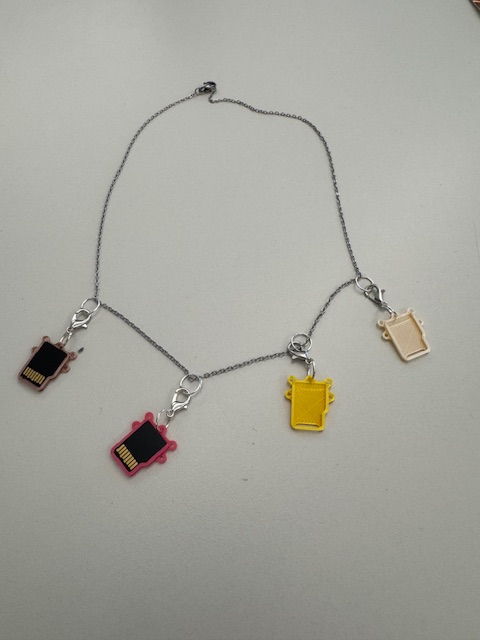
The first lecture was also the worst as their demo and presentation were ineffective. They finally got things going, and while the presentation was embarrassingly bad, the idea of SD Cards as jewelry intrigued me. Also, the concept of splitting data between the cards and needing, say, 3 out of 5, to reassemble the data sounded like a brilliant protection with a possible extra physical secret to protect it all. No sharing it. You could wear your data and protect it. Hmmm. I was already thinking of a new SciFi story about a rich uncle passing away and leaving you some SD Cards, and you having to find the secret and the extra cards to get access to his BitCoins.
The following lecture was about the harsh truth of body autonomy, given by the senior technologist, Daly Barnett of the Electronic Frontier Foundation, which fights many legal battles and is on the front line for abortion and trans rights. I learned that the abortion pills, though strongly controlled, are not as controlled by locals as some of the transition drugs are. Wow, justice with compassion seemed so far away after listening to Daly.
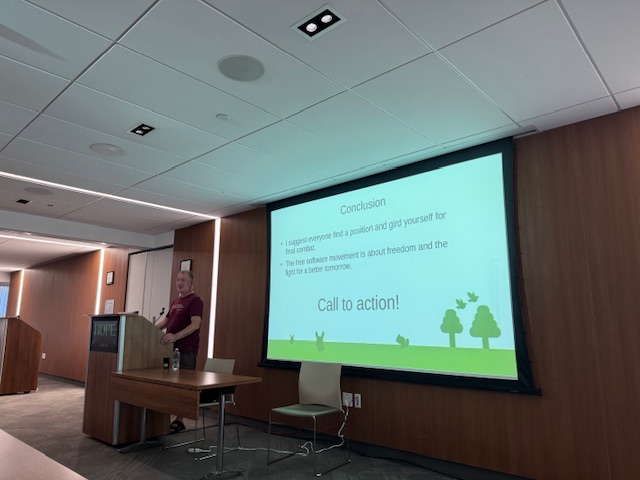
Next, I grabbed a prepackaged sandwich and more coffee, paid $15, and quickly ate them. I found the presentation by the Free Software Foundation (GNU, to some of us). I learned that the idea was published by Richard Stallman and got started back in 1983 (while I was in college). The presenter, Craig Topman, sought a solution to help the world and alleviate some of the madness. He found that working for the Foundation allowed him to make a meaningful difference. He made a strong case for us to join, listing volunteer positions that need to be filled immediately. There was some interest. I resisted (everyone wants me).
A bright high school kid gave the best history of the actual means to break the old Enigma machines. He covered how the Polish mathematicians solved it first. He then demonstrated how the updates to the machines necessitated additional assistance and how Alan Turing utilized both manual and electric machines (nearly computers, but specially built for a single task) to crack the code, building upon the partial solutions derived from the manual work. I did not know that Ian Fleming was the Intelligence Officer for the Enigma decoding effort. It was an excellent talk.
For the Enigma talk, I was able to answer a question because I had met one of the folks who worked with Alan Turing, and he had answered the same questions for me back in the 1980s. I repeated Dr. Peter Hilton’s answer that the Germans generally did not guess that their codes were broken, except Rommel, who gave many deceptive reports that understated his capabilities.
Lastly, I caught a lecture on how to build a police scanner system that logs all traffic calls and lets you listen to them in near-real time. It can track the frequency trunking done by the P25 system. It involves multiple radios and a Linux system to receive traffic files.

I headed out and soon found myself on the Q30 bus, but I got off at a stop a block from my usual one by accident (I couldn’t see that well in the dark). I reached my room without any issues, washed up, and then headed out to the dive bar, Emerald Pub, next door. There I got a beer, and then talked to some lawyers (whose lecture I missed).
Savy, along with a friend and her husband, was out smoking by the unfinished new phone tower. I chatted with them and they were friendly. I shared my phone number, and we will try to connect today at the closing ceremonies, and then they may join me for a trip into NYC on Monday and a museum or two.
I returned to my room and stayed up until after 11, chatting, texting, and doing some work on my laptop (none of which was hacker-related).
In general, I noticed the positive and friendly “you do you” vibe at HOPE_16. In many ways, Hope_16 is the after-party for Defcon in Las Vegas. About half of the folks I have met at HOPE_16 were in Las Vegas a few weeks ago. I was told that Defcon is a hacker school and that this is the fun, learn crazy crafts, and meet fun people conference. There are some learning options (there is a lecture on how to hack ATMs on Sunday — I will likely do a class on bookbinding instead), but it is more of a party and celebration. It is definitely not corporate.
I liked it.
Thanks for reading.

 Alohawild (Michael Wild's) Website