I am packing and changing hotels today. I hope to finish the blog later today; otherwise, you will read this late on Monday.
Going backwards again, I was in bed around midnight after walking back with Donna and Dondrea to our hotel for one last night there, Le Richelieu Hotel. The night was windy, and the wind was surprisingly bitterly cold. Donna froze, and we all walked back with enthusiasm!
We managed, after first sitting split up and with various poor views, to move to good seats at Fritzel’s European Jazz Club, and the house bands were excellent, if not hot and fun. All eight of us now! Michael R. and Seth got the front seats, while the rest of us eventually got the top bench seat. We did about four sets with Kathy and Doug headed out before the last one, and Michael R. and Seth left a bit later. Ken, Dondrea, Donna, and I finished together, leaving mid-last set to be done before midnight.
The All-stars—the last, best, and house band—was made up of most of the same band we saw on Wednesday, but today blues and jazz were played, not ragtime. Still, it was good. The piano player, whose name I again forgot, from Wednesday, without the cigar this time, sat in for two songs and got to lead for those. His family was with him today (he moved them into some seats that became available between bands) and seemed to have a great time playing for them. He was excellent at playing and singing jazz. His hands flew, and again I did not know how we played that many notes. I was thinking of our own John Nilsen, who makes the piano sound like bell chimes. How these guys do this is a mystery to me. Excellent.
Again, it was Sunday night, and I only like Bourbon Street on Sunday-Wednesday before it is filled with troublesome drunk people who will soon be revisiting their sins when the cheap Hurricane fulfills its promises. Ugh! Look for me on Frenchman Street on those days, instead.
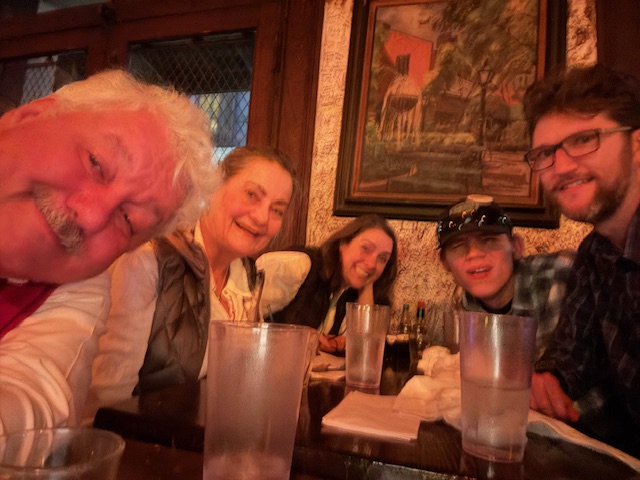
We had to wait before this as the folks arrived from the airport, all our flights worked, and we collected at Nepolean House. The hostess, looking besieged on a Sunday Night (but it was a game night for the Saints, the much-decried local NFL team), waited for us to collect everyone. A group of two tables inside (out of the cold wind) became available just as folks arrived. We were soon seated, and we enjoyed various sandwiches. Dondrea, Donna, and I got our excellent bread pudding, while Michael R. and Seth split a hot muffalata sandwich. Ken, Kathy, and Doug were at the other table and tried various sandwiches, including another muffalata. We chatted and caught up. There we left for Bouban Street and enjoyed some of the street bands on our way to Friztel’s. Bourban Street was already loud, but the crowd was subdued and cold. The wind was sharp now that the sun was done!
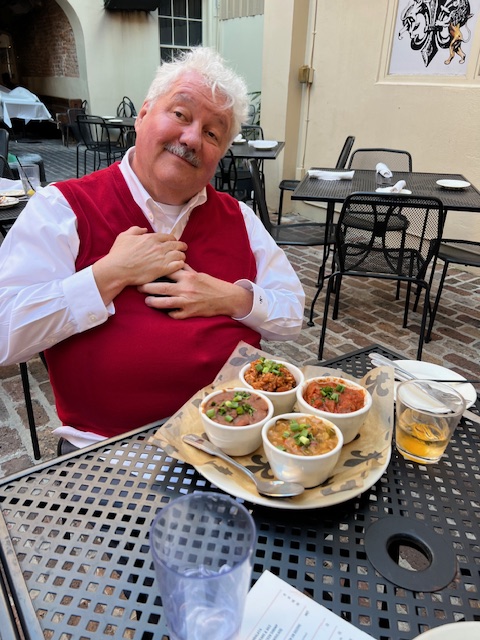
Before this, we picked for lunch after hearing the recommendation on our Grayline bus, and I was always curious, as I had never tried it, New Orleans Creole Cookery. I had only two beignets (which Seth said were like funnel cakes —I agree) and coffee before. And a mint julip with booze in it (I thought I ordered a virgin one; it was a happy bus ride back). I had the everything sampler while others picked food which focused on what they could eat (Ken and Donna) or wanted (Dondrea). It was not cheap, but it was excellent, and Donna, Dondrea, and I kept to an easy meal and a heavy meal with maybe a snack later.
We ate outside, and once in a while the wind would blow, knocking menus out of our hands or causing other minor problems. We had a heater above us, but it kept getting colder. The good hot food made it work.
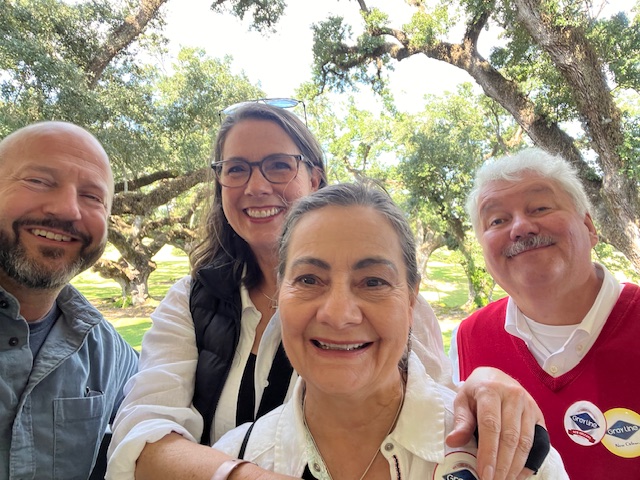
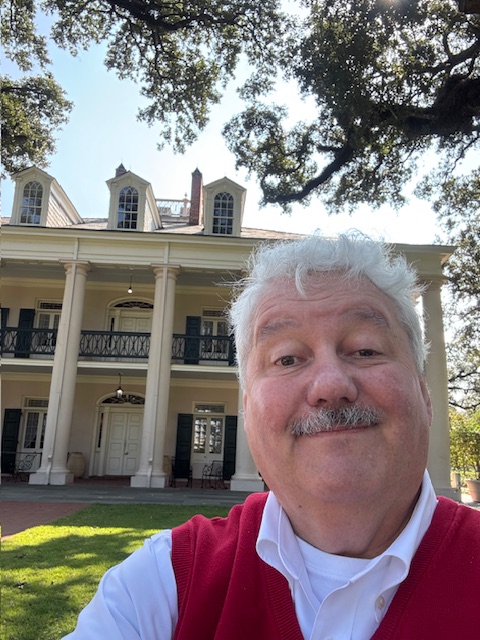
Before this, we were on a Grayline Tour of the Oak Alley Plantation with more focus on the economics of slavery than the evils of the institution and the terrors it brought to its victims. The slave quarters are partially reconstructed, and there is an excellent message there in your own self-guided tour, reading the signs and seeing the engine of slavery. Most terrible for me is the names of the slaves they have found in the records (80% still existing, according to the tour guide, though the personal letters are gone). The plaque reads that these names may be all the record of these people that exists!

The tour and the grounds are great, and I stopped by, as I said, got a drink, and didn’t taste the booze at first. Wells, our tour guide in the house, gave a good tour, slowly brought slavery into the discussion, and then covered it. According to our guide, this plantation house represents the owners, not the source of work or wealth, but rather the users of the labor of others. The plantation seldom made money, and the original owners died trying to make it work. The land was eventually divided, with the sugar barons buying the crop land. The plantation really existed for about twenty years. I have often taught the irony of the South: that sugar and plantations never really worked—a story seldom told.

Before all of this, I rose at 6:30 (ugh!), wrote the blog quickly, dressed, and met Donna and Dondrea for our usual couple of thousand steps to the louder section of the French Quarter. We found Cafe Beugnet’s food, though still doused in a load of powdered sugar, better than the others we tried. We had, starting out at 8:30, reach the place just ahead of the 9ish crowd. Pastor Ken was missing, and we heard from him that he was running late. He just made it, and I was the last person on the bus, having got him coffee from the now-packed cafe.
The bus ride (and back) was enjoyable, with a video playing on monitors about the various plantations—most open only occasionally to the public—and the story of Hurricane Katrina told by folks in New Orleans. The ride along Lake Pontchartrain and over the Mississippi on the longest bridge of its type was fascinating.
The bus driver stopped first at the Whitney, and we will be there on Tuesday—I will leave that story for then. We then took the River Road along the Mississippi and saw more of the remains of the plantations’ parcels of land. Sugar Cain fields are everywhere, and the levy now tall on the Mississippi. Each was a narrow but long parcel serviced by the road and the river. Large trees in a line were often the only signs of what once stood there. But this was the land of back-breaking, deadly sugar work, and the dinners and privileges of others living off unpaid labor.
It was a good day and we learned and enjoyed, but never without paying or a tip. Unlike the famous threat of Odysseus against the sponges off of others’ labor, everything was paid for!
Thanks for reading!

 Alohawild (Michael Wild's) Website