It is late Wednesday night, past 11, when I reach my room. I will try to write this, likely finished on Thursday morning.
I rose before my alarm, which was set twice, just in case, but I did sleep some. I was up to 1 a.m. the night before writing the blog. It was a difficult start, but the shower and mainly having packed the night before made it less of a mad rush. I did make coffee from the in-room coffee machine and replugged in the floor lamp. Now, at the last moment, I see the light switch I missed before. My phone, laptop, and battery were now fully charged.
I rolled my bag with my usual carry-on and headed down to the lobby. I thought I left the key upstairs—no matter—and I checked out (I found the key when I tried to get into my room here at a new hotel in Selma). I found at Holmes the name of the coffee bar and the former name of the department store that was here before. I ordered two coffees with danishes for Dondrea and me. Dondrea showed up a bit later. Ken, who also appeared, got breakfast while we chatted about our experiences.
We were back on the bus, but this time with our bags loaded. We stopped by Loyola University in New Orleans and were soon met by a bearded man with bright eyes, an infectious smile, and impeccable manners, wearing a shirt and tie. The room—a college lecture room—and Professor Will Snowden, a former public defender, were ready for us, with a PowerPoint already glowing on a board and a handout provided. Will Snowden is an advocate for improving juries, especially at the local level. We were here to hear about The Juror Project.
Simply put, the project is to make us all better jurors, looking forward to our duty, fulfilling our responsibilities to be available as jurors, and exercising our rights. Even now, the pools from which juries are drawn and the process seem to yield all-white male juries. Other issues, like low pay and poor sourcing of potential jury lists, threaten the process. For a trial and its verdict to be legitimate, the ‘promise of a jury of our peers’ must be kept.
Professor Snowden demonstrated the processes and discussed what he considers some of the issues in forming a jury. He took questions, and we even went over the changes to juries in Louisiana and Oregon. He covered Jury Nullification, when a jury refuses to convict someone even though the evidence is clear that a crime occurred. Often, he explains, this happens when a jury refuses to convict when they think the charge should be replaced with getting some help for an addiction. I was once on a jury and we refused to convict a person of a civil rights charge, as it seemed to us a ridiculous charge. We voted it down 0-12 to the surprise of the prosecutor.
Lunch was boxes from a famous sandwich place, Francolini’s, in New Orleans. Dondrea and I split a monster Gaga sandwich. We ate this on picnic tables that, obviously, being sunk into the earth, were now too low. We had a tour of the Whitney Plantation from the 1790s after lunch.

Our guide, James Kelly, gave us an excellent and often emotional tour of the sights. Many of these buildings had been moved here or moved from the original plantation or another location to a circle that allows easy tours. Two slave houses had survived, and I walked inside. It was sad to see the terrible place and boards and beams built by slaves and used by them. In our tour of Oak Ally Plantation, there were reconstructions, but these were real.
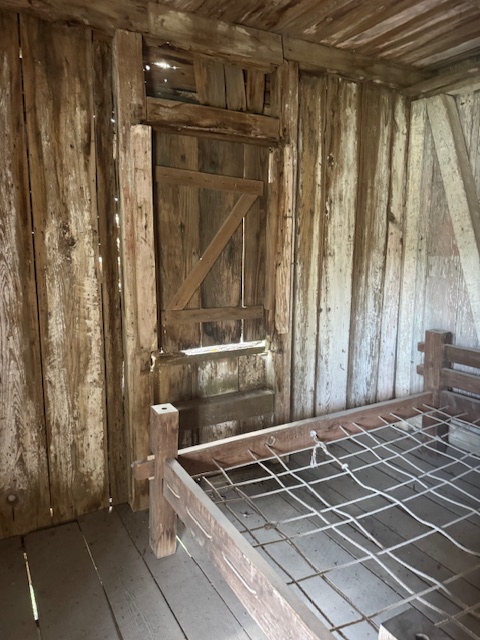
A church is on the grounds that was built by freed slaves right after the end of slavery. The building was replaced by a newer structure and the orginal hand built structure moved to the planataion to be seen by vistors and to hear their story.

James Kelly does only a few tours a week. He is a researcher and is very passionate about the false rewriting of history and abandoning the facts, and he calls it out on the tour. There is a horrific memorial to a large local slave revolt that failed. I saw him pick a rose, kneel on the ground before the name of the leader, a woman who was executed, and leave it on her nameplate. He then prayed. He rose, another guide told the story, and then James added more.
Aside: James reasoned that the revolt leaders were not planning to escape but to fight. I agreed with him. Napoleon grabbed a few cannons in Paris, along with some men, and rescued the government from a crowd. His success gave him his first leadership role in France. I cannot imagine the story, fresh, was not retold by other would-be revolutionaries. So I told James, for this reason, I think he is right. He liked the idea.

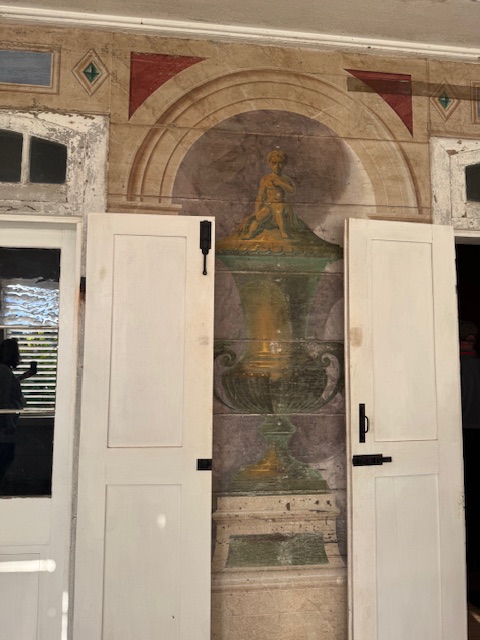
James walked us through the exhibits, some purchased from auctions from other plantations, but most were real or close to the originals. He took us into the Big House, which was empty of furniture and in good repair, and included paintings from the 1850s. I was surprised by the floor, open boards just under 1/2 of wood. Minimal, and I wonder how much furniture it could hold up.
James took us to the garden where the children who were lost to slavery are remembered. Thousands of names of children with their dates of death, a Victor dying on my birthday, passing away 110 years before my birth. It was hard not to cry, and this was only the names they had for children lost at Whitney Plantation. I did cry at the memorial for the revolt.
DeSean gave a lecture on the moving bus; he waited a while. We had five hours of busing (irony of those words was not lost on me) to reach Selma, Alabama. DeSean covered “The Civil War Reconstruction and the March to Civil Rights.” This area was history I knew well, and many could answer DeSean’s questions.
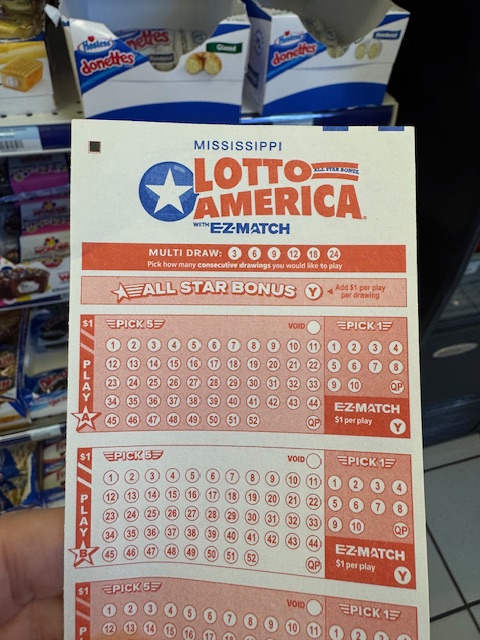
We stopped for a break in Mississippi. I found this.
The people of color with us shared that they were experiencing rage, grief, and acknowledgment that they were survivors of slavery. I felt the story of Whitney hurt me and weighed heavily. DeSean, our leader and a person of color, told us he understood the material weighed against us. He had given us a break while we processed.
DeSean’s words seemed stronger now: “We encounter hard truths; they cause emotions.” The buildings show the skills of the enslaved labor, he pointed out. He explains that everyone lost the American Civil War, not just the South. The destruction and the abandonment of Reconstruction restored many of the evils of slavery under the new Jim Crow and Black Codes. The Klan rises. The false replacement history of the Lost Cause, the false legend of Bobby Lee (as pointed out early by James Kelly), and the false legend of a noble war of good people resisting an out-of-control central government soon fill our textbooks and school lectures. The truth is lost (and seems to be the focus of the current government, which is again raising this false story).
Aside: Sorry if these words are a bit unfiltered. I wanted to capture my feeling and my understanding of the story I was told.
The long bus ride includes a nap for me and Dondrea (and others, I am sure). DeSean takes up the microphone again and covers the post-war horrors of the Memphis and Clinton Massacres. We arrive at 9ish for a later dinner served to us by a local group in Selma, By the River Center for Humanity. There, after a plain but excellent pasta with white chicken sauce or a ground beef tomato sauce. I have both.
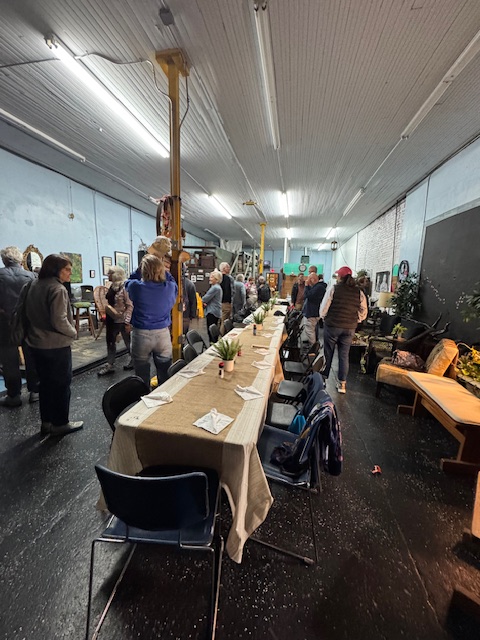
Anika Jackson, also serving us, is a leader in nonviolence here in Selma. She tells us some of her words: “Truth is not to be argued,” “We are not sure we are right and so we argue,” not white/black but our history, “Once I love myself and my people, I can love others,” and when I remember I am the servant and not the savior, it works.
We were all tired, dazed, confused, and angry. She had us dance and sing, and that helped. It wrapped those hard feelings and weighty topics in music, dance, and fun.
Soon, we were in yet another hotel, and I was happy to slip under the sheets and dream of nothing, as only tears and screaming were possible in those dreams. Pure calming darkness was welcome.
Thanks for reading.

 Alohawild (Michael Wild's) Website
1 thought on “Wednesday Telos New Orleans, St John Parish, Selma, Oh my!”