I rose today at 6:45 and was ready for the breakfast bar provided at the meeting. The food was good; New Orleans never serves anything that is not good. I had finished the blog and slept, waking a few times.
DeSean and Frances from Telos were there, and DeSean gave us a PowerPoint presentation over the next couple of hours entitled “Belief, Brutality, and the Business of Slavery.” There were a few points of input and discussion, but mostly it was, in many ways, a depressing and harsh look at Slavery and also the fate of the indigenous people.

DeSean used words like “continue grounding ourselves,” “grief of the reality,” “legal fiction and out of the ether” for truths we think we know, our place here in the city in a state in the USA, but also a reality of being Chitimachu Tribal Lands, “empires say we don’t see culture and divine,” to kill people first redefine people to be associated with the land, “what we do with this knowledge is to peel back the reasons,” and “slavery was engineered,” and needs tools (religion, laws, trade and commerce, and story and narrative).
DeSean describes the fate of native peoples as a lesson on how oppression works. He calls out the book
We then covered Code Noir, which is the Spanish rules for slavery. The purpose was to establish regulations that offered hope and some rights to the enslaved. It mainly was, according to Desean, a method to prevent uprising. Oppression mixed with religion. DeSean said that slavery was profitable, and during the days of slavery, the state of Mississippi had more millionaires than any other state. “This is a serious system. It takes this kind of seriousness to work these injustices,” DeSean concluded.
Note: I don’t usually tell someone else’s story, but this time I think it is appropriate.
We boarded our bus and soon headed across New Orleans to St Roch Community Church to meet Jerome and Robyn (may be ‘Robert’ and I heard wrong). They were wrongly convicted and jailed for years. They described their story, and I tried to follow along. I was not close, and the sound system did not improve my hearing. What I took away was that both were undereducated and, with no real opportunities, turned to drugs and crime. They were in the area of a murder, and were scapegoats, or in the words of one judge, Robyn told us, said, “the evidence is confused, but you look like the kind of kid that would do this.” Both were legally convicted without real evidence, and questionable tactics were used to assemble witnesses to identify them (these tactics are no longer legal).
Jerome told his story first, and he said to us, “Making the world better will take all of us.” He could not believe, as he was brought into the facility for a life sentence, that folks were manually picking cotton. He spent years getting an education and finally got help to exonerate himself.
Robyn said he had finally gotten himself a GED and an education and finally connected with folks to help him. But the legal system still continued to pursue charges against him. It took long years and money from his family to finally be declared innocent. “Allegiance to the truth and not being motivated by fear” is how to live and survive tragedy.
Both Jerome and Robyn told us they both knew they were innocent and believed, at first, that the mistake of conficting them would just be corrected. That the system of justice would naturally exonerate them, but it did not. It took years, and they had to get an education and help to get released. In the end, they said, we are human and we must help each other. Their foundation is here.
I have often wondered about the work of Prison Ministry, and the story made me think about how I could help. I am unsure if I can fit it into my life or my church’s work. Michael R., Dondrea, and I talked about it later at dinner. Hmmm.
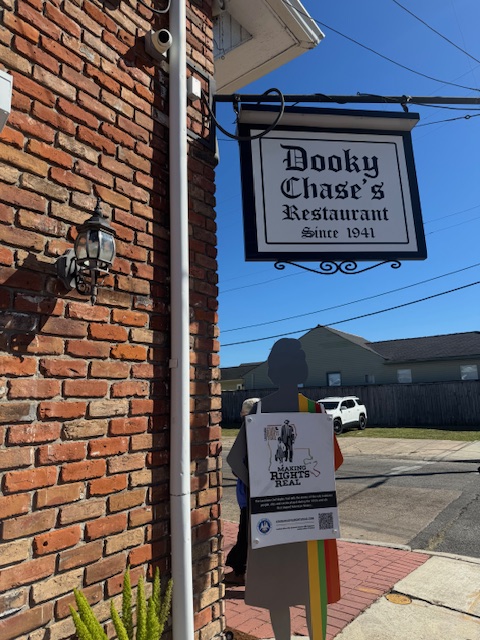
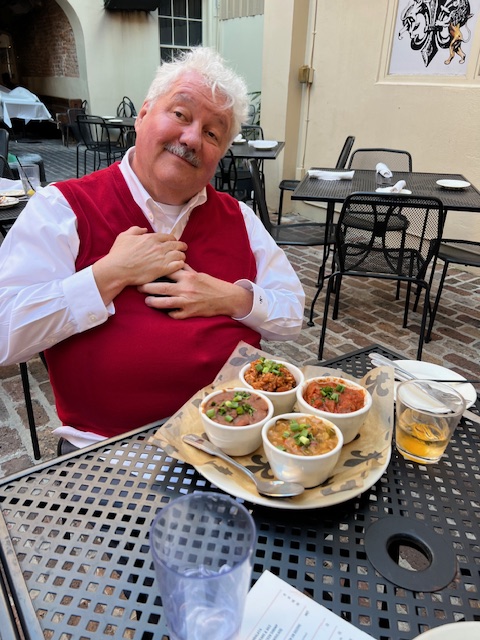
Next, we stopped by Dooky Chase’s for lunch, which was listed in the Green Book (here, if you don’t know its story) as a safe place for people of color to dine. I had the fish and it was divine. Dondrea tried the fried chicken, which was good. I have always wanted to try the place and experience the ambiance of an institution that is now. The gumbo was excellent, and the sausage in the soup was spicy and clearly local. Outside, carved in stone were the names of presidents, Supreme Court Justices, famous actors, and people who have all eaten there. And while I don’t expect to be added to the list of names outside, I did feel like I checked off something on my list.


Cancer Alley is a part of St. John Parish that is full of more than a dozen chemical plants that have the highest cancer rate in the USA, according to Tish Taylor and activists who live there. We picked her up on the bus as we entered the area. She explained that folks of color were redlined out of other places, but they all felt lucky to get a lovely home in beautiful St. John Parish. The old plantation land was being offered to them. They did not know that the chemical companies were also provided the land, and that their land was considered sacrificial, to be polluted by waste and leaks from the plants. The community was built, and soon after, dozens of chemical plants were built.
The homes and area are lovely, and the green of sugarcane is everywhere, right up to more than a dozen petrochemical plants and other chemical plants. Many buildings I saw were boarded up, as were some homes, but most were bright and looked like perfect places to live. According to Trish, the toxic chemicals are often 400 times more than the recommended safe levels here. The local government has stopped enforcing any controls. One plant is finally closing—a win for people like Trish—after boycotts and various documentaries made it financially untenable to keep it open.
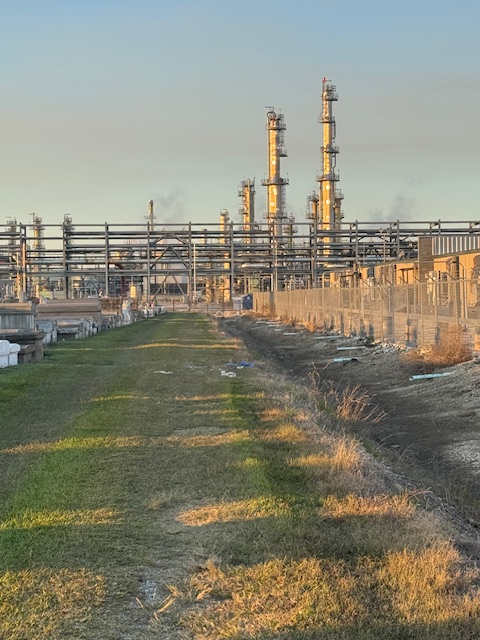
Trish took us to a ramshackle graveyard to meet her family (the ones who have passed), and she showed us the graves. The plants are up against the graves as the chemical plant companies bought and demolished the church. The noise and smell, and later a burning sensation (which may have been psychosomatic), made the visit unpleasant. She told us she wanted to feel the plants’ impact on their lives. It was a forlorn place and terribly sad. I nearly cried.

For me, it was a terrible story of betrayal. It is worse to stand on the land and see the graves of the families trying to make a living there and demanding that the chemical plants stop harming them. Trish was friendly and funny, but you could also hear anger and exhaustion.

(Tiny, lovely flowers I spotted at the edge of the graveyard)
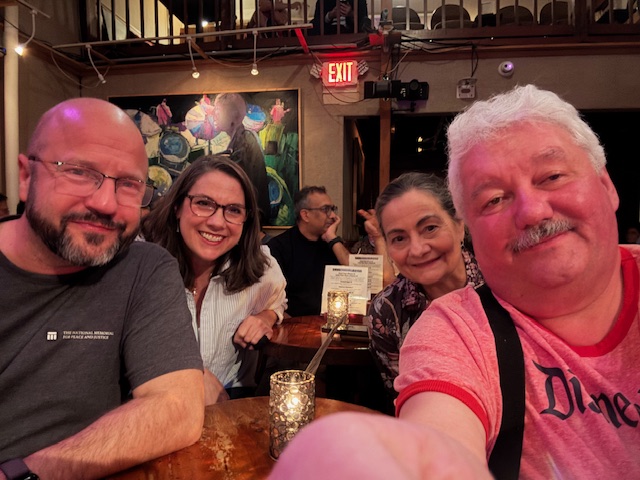
The trip back was long, but soon we were getting off the bus at Plates for dinner. This was another included meal, and we spent some time there chatting, eating, and thinking about what we had heard today. This mix of reality—some dark, alternative, hard-to-be-there reality—and good food and chatting is a good way to balance. I remember DeSean saying that balance was important. I am beginning to understand.
Dondrea and I decided to walk back to the hotel. Kathy took the bus (Doug was ill today). Michael R., Seth, and Pastor Ken headed to Mahogany Jazz Club. It was not as cold or windy, and we enjoyed the walk. We skipped out of the sketchy, dark street and soon were in a shopping and legal section. We went to Lafayette Square and then found our way to the hotel. I wanted to see this area in more detail.
After about thirty minutes, we reached the hotel. In the lobby, we met the folks from our group and chatted for a while. Tomorrow is a hotel change, and Dondrea and I decided to work and pack. I spent the next couple of hours writing and packing.
Thanks for reading.





 Alohawild (Michael Wild's) Website