I rose again with the sunrise over NYC and looked out my window. I would, before I wrote a blog, shower, dress, and walk the city as it woke up to another day, but now I write and watch the colors change as Manhattan opens to another glorious sunrise in my room. The discipline of years of writing helps, but I still feel a call to the outside; today is an all-inside day. It is a Hacker’s Conference, and Hope 2026 is inside with pale computer SecOps folks.
The crowd is a mix of older people, many showing the effects of a life as a computer specialist, heavy, or young people showing a mixture of difficulty with social interactions, indeterminate gender, or an intensity of overcompensating for social difficulties. Hackers. Some will be looking intently at screens during talks, while others tap fast and take moments to work on something with complete attention.
The Opening Ceremonies for Hope 2026 are at 10:30, and my vouchers are done: I have to buy breakfast. I invested the first hours in writing and rushing. I am excited to start and also worried I will feel out of place. I am not a hacker or SecOps expert. Still, it is exciting, and I push out over a thousand words.
I talk to Deborah once I get started, and it is good to be in the same time zone. We will connect here and there between items. I also spoke with Dondrea about some church matters, and I am deeply disappointed by some findings that I will not describe here; I am not sure what my reaction should be. I try to keep my focus on the reason to be here: Hope 2026.
The opening ceremonies were more of a welcome and a celebration of being back in Manhattan. There are memories of people who have passed and how happy they are to make this work. Kyle, the network builder, says it was very difficult this time to get the powerful network function working, but it is now. Hope 2026 serves near-real-time remote content with huge volume needs. It fends off hacker attempts as a matter of pride. It is safe, maybe the safest, fast, and carefully monitored. The hardware, NOC (Network Operations Center), is here, not in the cloud, and resides on the Grand Ballroom balcony.
“Reclaiming the color orange,” explains the reflective safety orange as one of the themes. The construction theme is about reclaiming the narrative, rebuilding, and resisting the takeover of social media and the Internet by corporations, as well as the divisive speech I heard. “We don’t have to be that way; make it as comfortable for others as possible,” is scrawled in my notes. There is a reminder that smoking, vaping, and similar activities are forbidden in the hotel and that they have sensing equipment, they are told. There is a statement to leave that alone, respect the hotel, which has been great, and not defeat it. There are nervous laughs, like children reminded to play nice with others. And with that, the first sessions begin.
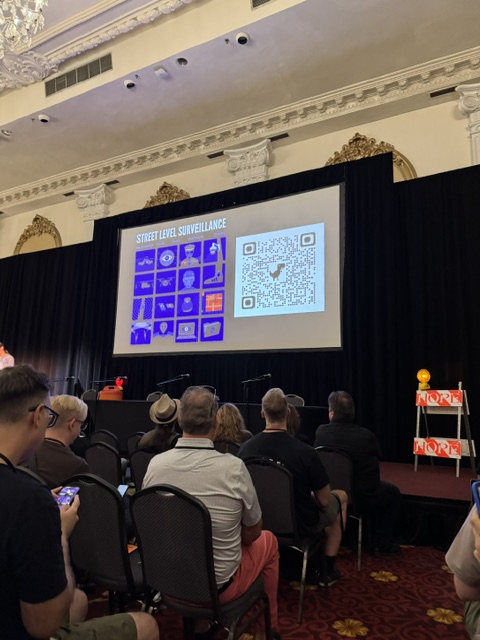
“Cameras, Cops, and Cell Towers: A Field Guide to Modern Surveillance” by Michael Raymond, whom I have heard before, starts my sessions also in the Grand Ballroom. He points out that the company Axon, formerly Taser, makes lots of the equipment. He also reminds us that many HOAs, stores, and law enforcement agencies have cameras and share the recordings. He was unable to defeat the face recognition with makeup or by wearing another tiny face on his glasses. He covers Flocking, and a Freedom of Information request, with proper understanding of what to request by doing research into what the local government is using for tracking, is the best way to check if your information is being checked.
Interestingly, the high-tech Stingrays, the name for fake cell towers that can easily track cell phones, are not in use as much as was thought, he reports. The hackers have a hardware box for spotting the fingerprints of a Stingray. He supplies, and I have photos of QR codes to help resist this surveillance.
The Flock cameras are given special attention. Flock cameras are, I learned, just a Raspberry Pi with a camera, powered by solar cells, and connected to Flock’s network. And while of questionable legality, he suggests that these devices are easy to cover, cut down, and make nonfunctional. He also points out that Axon now tracks Flock’s rejection of selling the same service using Axon equipment, which is less well known.
Flock also tracks bumper stickers and other vehicle markings, along with make, model, and color information. I share this information with friends who are facing harasment/stalking. Michael’s talk was worth the price of entry, I think.
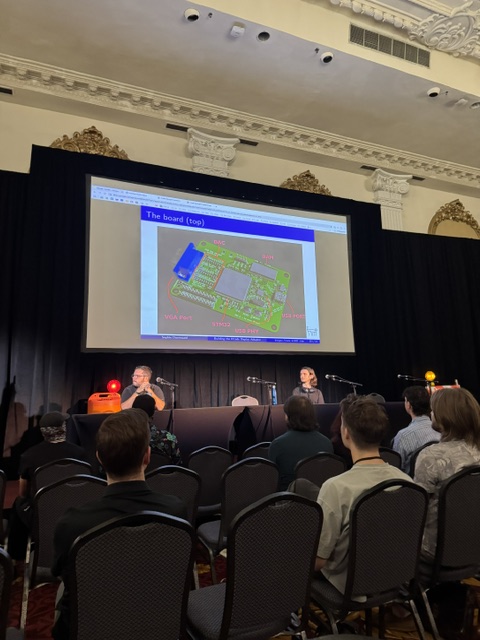
Next, “Building a Community Arcade Cabinet by Frank Chiarulli, Rose Hall, and Sophie Downward covers some of the details for bringing a video-tube arcade back to life. Sophie covers how they designed a USB-to-VGA conversion board, including surface-mount parts, to control the screen. A resistor was missed for a crystal-based timer, but Sophie tells the story of her putting her finger in, as the resistance of a human body was a close match, and suddenly everything worked. I and others I spoke to later want a copy of that board. Wow!
They used Rust for embedded work; I have looked at it before. Interesting. They also all met at a hacker space in Brooklyn that offered a six-week break from coding to explore and be imaginative.
I stepped out, as the hour-long sessions were less interesting, and headed a block away to the Irish bar Tailors, where I had lunch. I ordered an iced tea that turned out to be carbonated; the bartender took it back. “Yeah, it is terrible.” The Shepherd’s Pie was good, and I ate it quickly. I met another person from the conference from Washington, DC, who had just arrived by bus. Sticking out of their backpack was a plastic pigeon that apparently is a family thing and is carried all over the country. Today it is in NYC.
“Leaking & Investigating the Epstein Files” was the next surprising option. The session included two writers, the person who represents the secure validation and release of this information, and one remote “Kyrie” hacker who released the trove of Iranian hacks of Ehud Barak’s emails, which contained more Epstein information. The former prime minister of Israel had a business relationship with Epstein.
The hacker obtained the information, tried to sell it, and finally released it to Distributed Denial of Service’s Emma Best, who protected the information and the “Kyrie” and confirmed that it appeared to be real. It was released “to do the right thing,” and the hacker was given questions earlier, and the answers were read only during the session. It was pointed out that “Kyrie” could even be in the room.
Emmy Best said that, when asked what she was most disappointed by in this process, the lawyers giving advice in the emails on how to avoid trafficking charges by rerouting abuse to other places should have been at least disbarred but were not ever even charged. Hmmm.
The next session, “Seeing Inside the Mind of AI,” was not very good, and I will not cover it here. But I did get one good quote: “Good systems radiate information to use safely.” But the next one, “Spacesuits, Mars boots, and Vegan Roots in the Desert Regolith,” by Scott Beiban and Elizabeth Jane Cole, was fun, though they were late and took 10 minutes to set up. They are volunteers conducting space-analog research for EV suites on Mars. They told the story of their difficulties and how they built a suit that simulates some of the challenges (cooling is needed next time, they explained, as they boiled in the desert heat in the uncooled pressure suits). It was fascinating to hear about their somewhat madcap adventures testing and building the suits. They have designed a habitat for Mars and have named their venture: Offworld.Voyage. A vegan-only plan for Mars.

“Nikola Tesla’s Time at the New Yorker Hotel” by Jeffery Velez was next. I learned that Tesla lived on my floor, the 33rd, and that his room and place of death were across the hall. He spent the last five years quietly in room 3327 at the hotel (I am in 3319). Wizard is the book that is recommended. I also learned that Trump’s uncle reviewed Tesla’s notes after his death and that President Trump demolished the first building bearing a Tesla plaque.
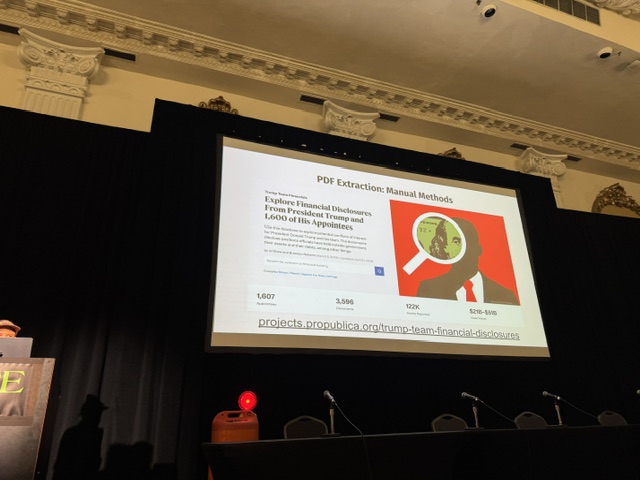
“Hackers: Journalism Needs Your Help” by Brandon Roberts of ProPublica was my last session on Friday. I was surprised to learn that there are tools to review government forms filled out by various officials and thus made available to journalists. I also learned that data cleaning and verification are a big part of the work now, and “bullet-proofing” findings from multiple sources is critical. They need updated tools and parsers to extract the relevant information (and what is missing). President Trump and Vance have provided their forms, but distorted the characters to make them hard to read with tools. They will need special OCR processes that are not available.
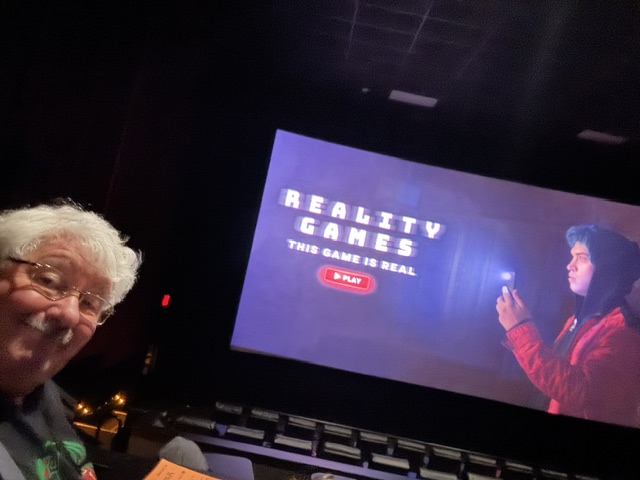
Lastly, I headed to the movie at the AMC theater across the street, Reality Games: Control the Narrative. It is a fun hacker movie about a fantasy of two young men finishing high school and then betting to “ruin their lives.” The movie is about a bet going wrong, shadowy organizations, and both believable and less believable hacks. It is a moral story where you find yourself, as the audience, cheering for the hero and then discovering the truth, feeling betrayed by the hero, and learning that social media and the act of cheering without enough information to make informed choices- real information, not clickbait- is the real problem. Interesting.
I talked to Kyle, our network builder for Hope, and he told me the story of how they finally got the Telcos to allow access to set up their closet. It was hugely stressful, and Kyle said he felt like he had grown up to managing relationships and reassuring people. No longer only tech stuff. The hotel management finally convinced the Telcos to work together. Kyle was happy to tell me his story.

After that, and more church stuff in my email, I headed back to my room, stopped by and looked at the door to the Tesla Room, and soon slept.
Thanks for reading.


Excellent content Michael, thank you!
LikeLike