Blog

Monday Travel Day Back to Oregon

I woke early again, 7:30ish local time — sleeping in — and started on the blog while the sun rose through my window. The view had changed. Most of the buildings were now shrouded in white-gray as low clouds swallowed the tops of buildings like an inverted avalanche. Today there was no view of the Empire State or Chrysler Building to enjoy, and the city was shiny with rain and mist. Monday seemed like a surprise to the city, and traffic was down, as if everyone was late for work.

I wrote quickly as I had yet to pack (a process of squeezing random bits back into a small rectangle). Check-out time was a kind morning time of 11, but I like to beat that by an hour. My handwritten notes helped me quickly reconstruct my Sunday, along with the photos I took. Some of the afternoon lectures on Sunday were given by folks who had trouble assembling a narrative to share with slides. I tried to be kind in my recap of Hope 2026 Sunday.

I had to close my bags twice while packing before showering, and I forgot my PJs were on. I managed. I showered, shaved, and all that. I got a knock on my door around 9-ish from housekeeping. “I was not ready to leave yet,” I told the person. Later, I saw them in the hall and told them I was checking out. It seems housekeeping wanted to finish rooms quickly and early. I usually see them run late at most hotels I stay at.

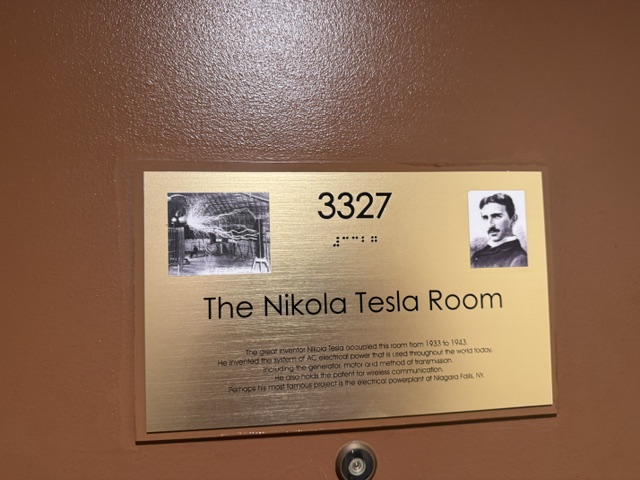
I rolled out, said goodbye to the 33rd floor, and thanked the floor. Tesla’s floor, room 3327. While many would think it silly or spooky to thank an inanimate object, I find voicing my thanks to a hotel makes me feel better about leaving. My home for a week.

Check-out was productive, and I paid $5 per bag to store my two bags for the morning and part of the afternoon. I tried Tick-Tock for breakfast, as I was unprepared to face another bagel with 1/4-inch of cream cheese. The Monte Cristo was not as good, and I ate it by cutting it up. I skipped the syrup, as I like it better with jam.

With my bags in storage, coffee purchased and drunk, and just an average breakfast consumed (bagels all the way next time), I headed to The Strand Bookstore. I used navigation to find a subway. Something went strange, and it walked me around a whole set of blocks in a circle, and not to any subway entrance! I walked almost in a circle and found it was walking me to The Strand, sort of. I canceled that at the Madison Square Garden entrance, two blocks from my hotel, after walking six blocks to get there (?!). I walked to a subway station two stops away from Washington Park, then walked an additional two blocks in a direction not recommended by the navigation app. Ugh!

It was hot and muggy, and soon I was a bit damp from the outside and my own sweat. The subway was oppressively hot, and my joints were not enjoying the steps today. I arrived and was thrilled to be at my target, even after paying $3 for the short trip.

I did not stop to play chess, and I am always shy about looking like a goof in front of a professional, but I did see the same person I played last time. He had a tent over him against the weather and was lightly dressed. I reached the local comic shop, Forbidden Planet, but the next issue of Dr. Doom, #4, was not out yet.

Here, my colon decided it wanted attention. I was surprised, as I had not had any issues on the trip. I finally found a bathroom at The Strand Bookstore next door. The person at the desk was unfriendly and pointed it out. A NYC moment, but the desk was next to the bathrooms; I think the person was already tired of bathroom code requests. The rest of the store staff were a bit more friendly, but still had that NYC edge.
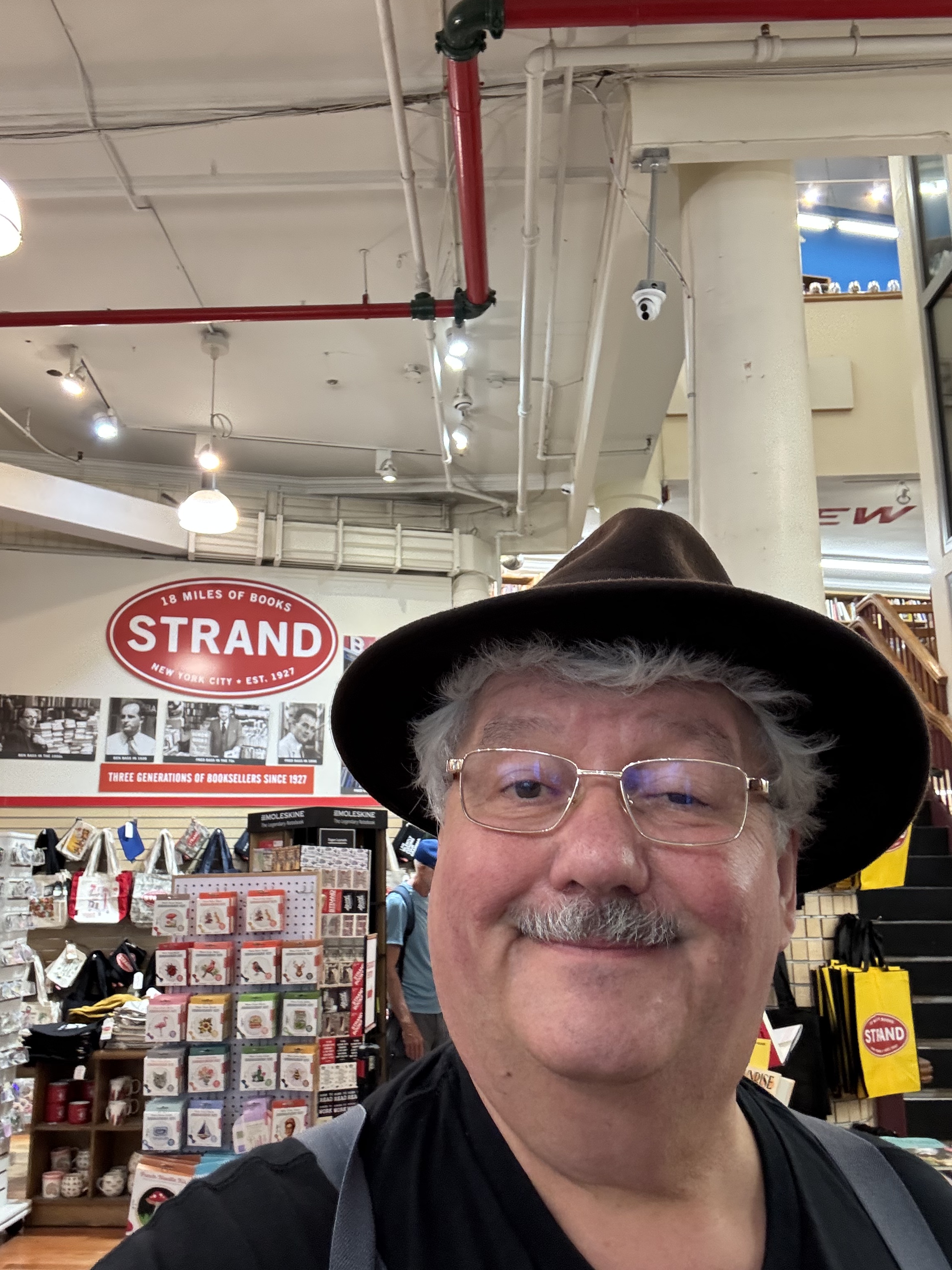
There, I located some NYC gifts to send to people when I am in Oregon. I also found in the “Best of the Best” a book, translated into English, Days at the Morisaki Bookstore by Satoshi Yagisawa, which I could not put down and finished 1/2 before I got on a plane at JFK. It is only 145 pages and easy reading.
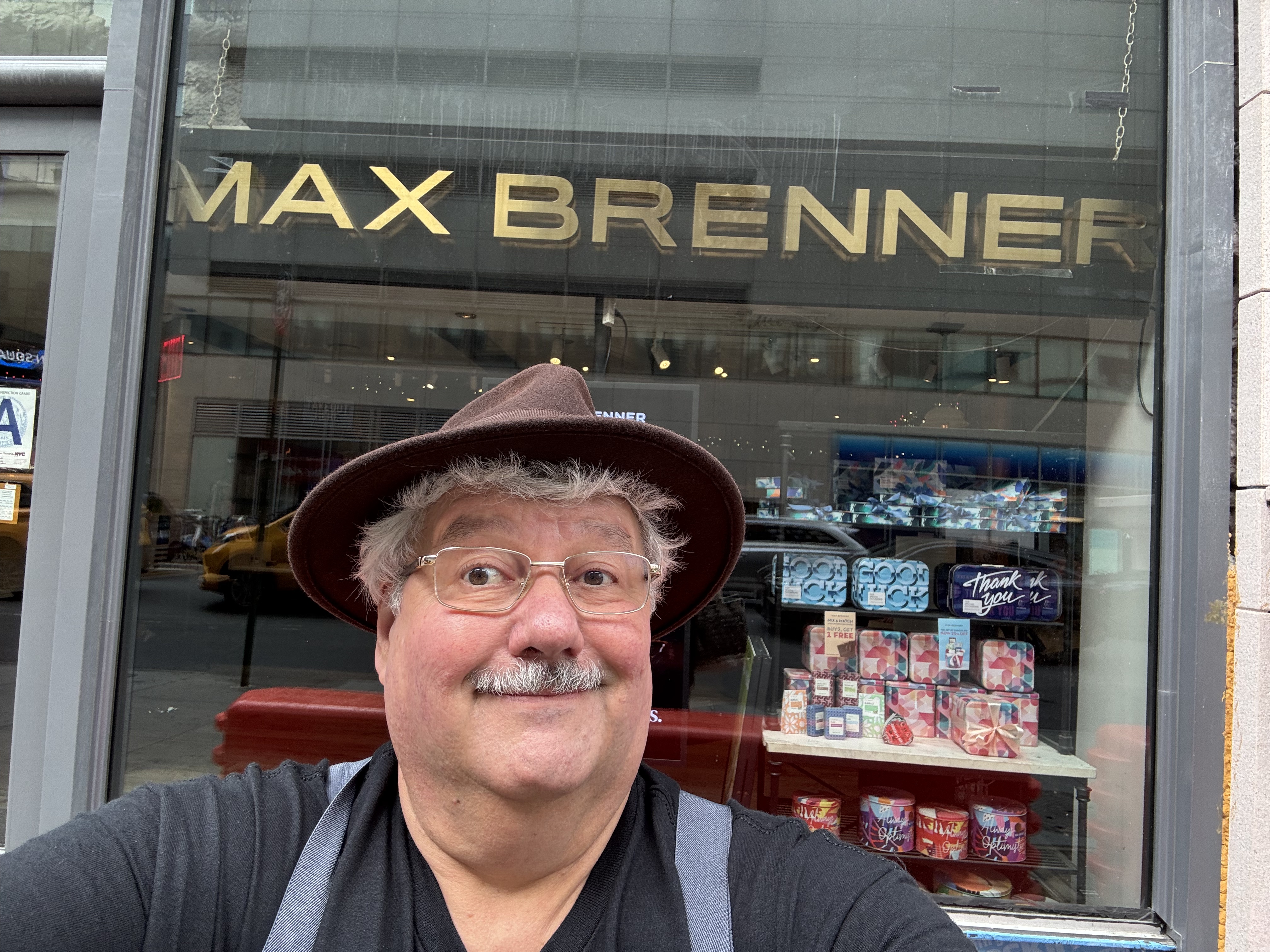
With my insides calmer, I stopped at the Max Brenner Restaurant, a chocolate shop and restaurant, for Mexican Hot Chocolate; it was just 11, and time seemed to slow so I could see more of NYC. I also found, from a poster I spotted, that the late Menachem Mendel Schneerson was now a messiah figure. I have followed the movement around this religious figure for a while after receiving instructions from his group on how to be a righteous gentile. I lost track of them after they stopped sending me information when I let them know I was not Jewish. I remember how the community around him was disappointed by his passing. It seems things have changed since I last heard from them.

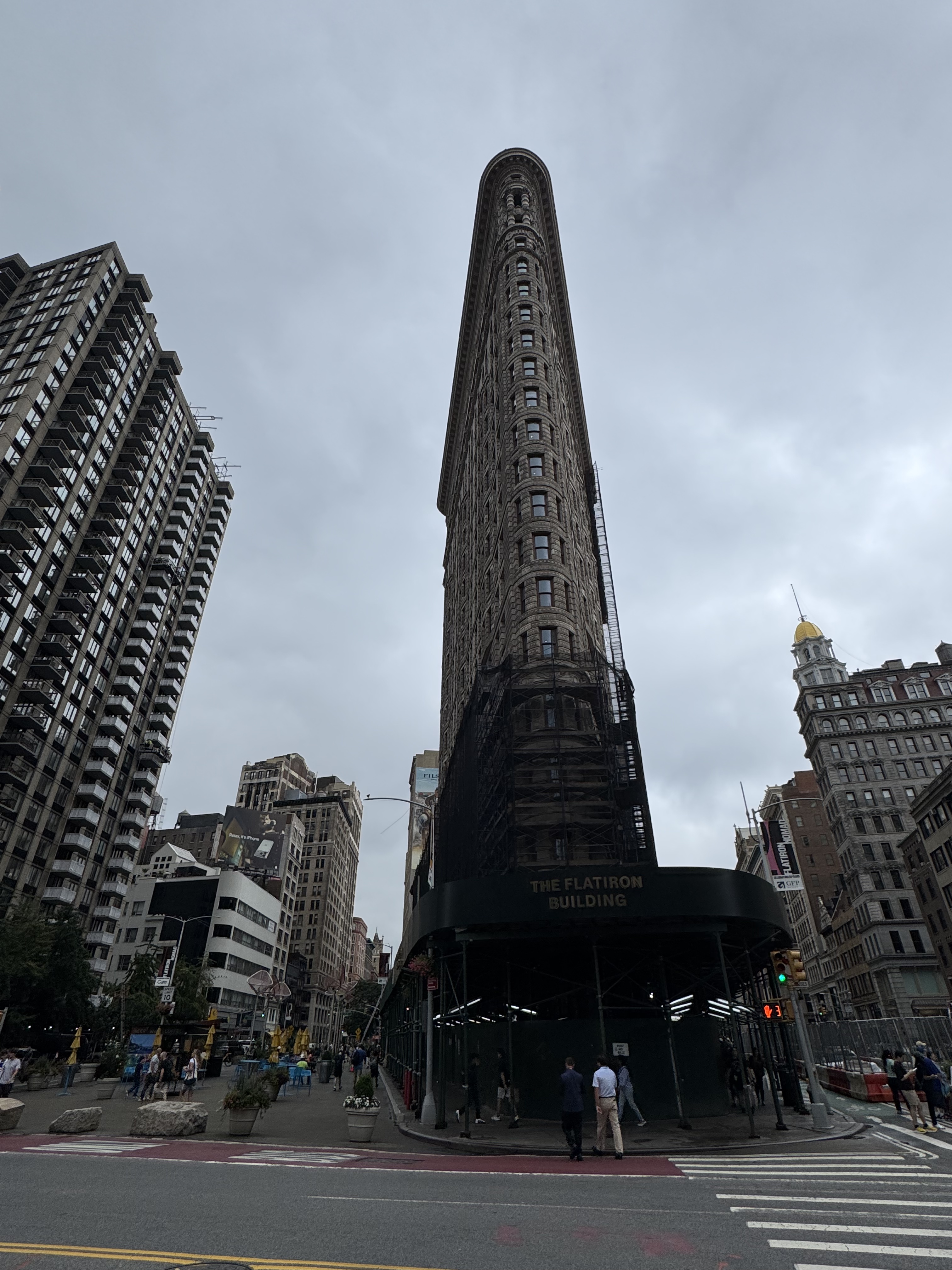
Deciding not to try chess again, I returned to the subway and took a short trip to the Flat Iron area that I had never been to before. John Wick’s fictional Continental Hotel was undergoing a conversion from commercial to residential housing (expensive housing). The building has been in a bad way for years, I read, and this conversion is seen as a salvage rather than an update.

The Teddy Roosevelt Museum (his birthplace and museum) was closed on Mondays. Next time. I sat in Madison Park and read as the rain had stopped, and I found a mostly dry chair. I passed on many places for lunch on my way back to The New Yorker Hotel. I again had trouble with navigation and walked the whole distance. I was going to ride the 1 Train but missed the entrance. I was warm and damp when I reached the hotel and then got lunch, again, at the Irish place, The Temple Tailors, the next block. I had a red ale and a beet salad. It was good, and I felt better.

I picked up my bags, saw some more folks from the conference, said our goodbyes, and then I rolled my bag to Penn Station IRR for a quick trip to JFK, just under an hour. It was about $8 for the train and another $8.75 for the air train. I did not have to carry my bags except once to reach track 20.

The IRR, with my paper ticket collected by a conductor, was not crowded and pleasant. The AC was mostly working, but the humidity was still heavy. The AirTrain was jam-packed with people and their bags. I did chat with folks, continuing to be my usual social butterfly even in the sardine-like experience (if fish had luggage).

I arrived and went the wrong way, a theme for today that I was not really enjoying, and walked to baggage claim to return to floor four to check my bag. It was a sea of Delta customers, and I passed along my status to use the less-busy First Class process. I did help some folks with the process by asking an agent to rescue the person in front of me. I managed to make a new mistake but did remember my phone. My bag fell off as I was called to check my bag, and my book was left on the floor without me noticing. The janitor brought it to me.

Next was the awful security loop in a poorly AC’d part of JFK, and it took thirty minutes to reach the TSA agents. JFK is a reason to have PreCheck TSA, but I have not done that. My suspenders had to go in their own tray, but otherwise nothing went sideways in security.

My gate was the last one on B, of course, and the concourse splits about at 24, if I remember right. It is a blur now. It took 12 minutes to reach the gate, according to the signage. I was ten gates away when I saw what my watch was trying to tell me. Gate changed to B24, not B55; now noted at B40. F**k. I managed to walk farther than if my gate was the farthest one. Wow!
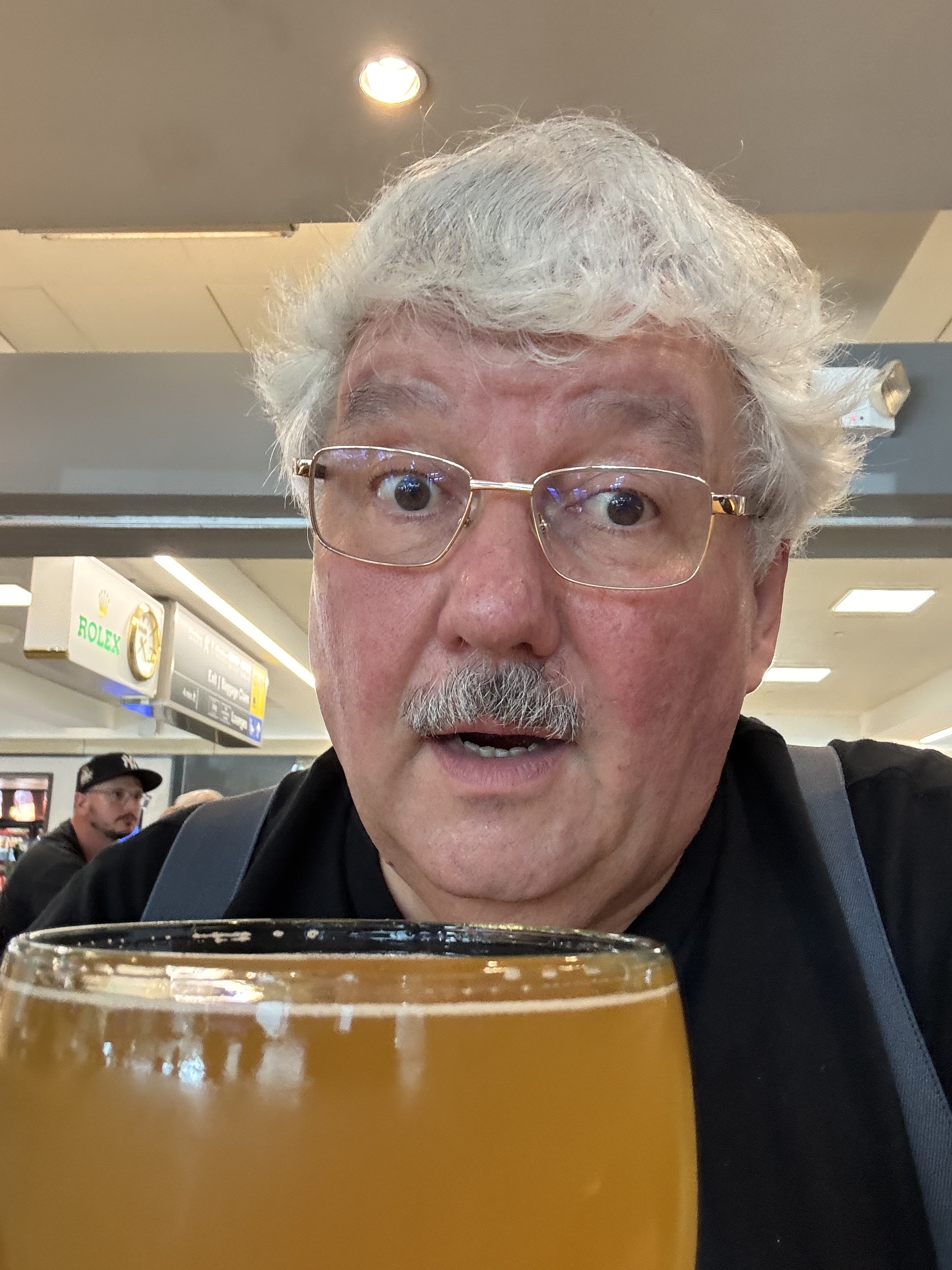
I walked back and noticed that Wild Buffalo Wings, which I had been tempted to stop at earlier, was next door to my new gate, B24. I found a clean table; the open bar seating, my usual choice, was less clean. Soon I had a large beer, the only size they had left, and waited for ten overpriced wings to appear. Yes, $43 bucks is a lot for a beer and ten wings. I rushed at the end, but discovered that my plane was twenty minutes late. I did make it to the restroom to clean up all the sauce.
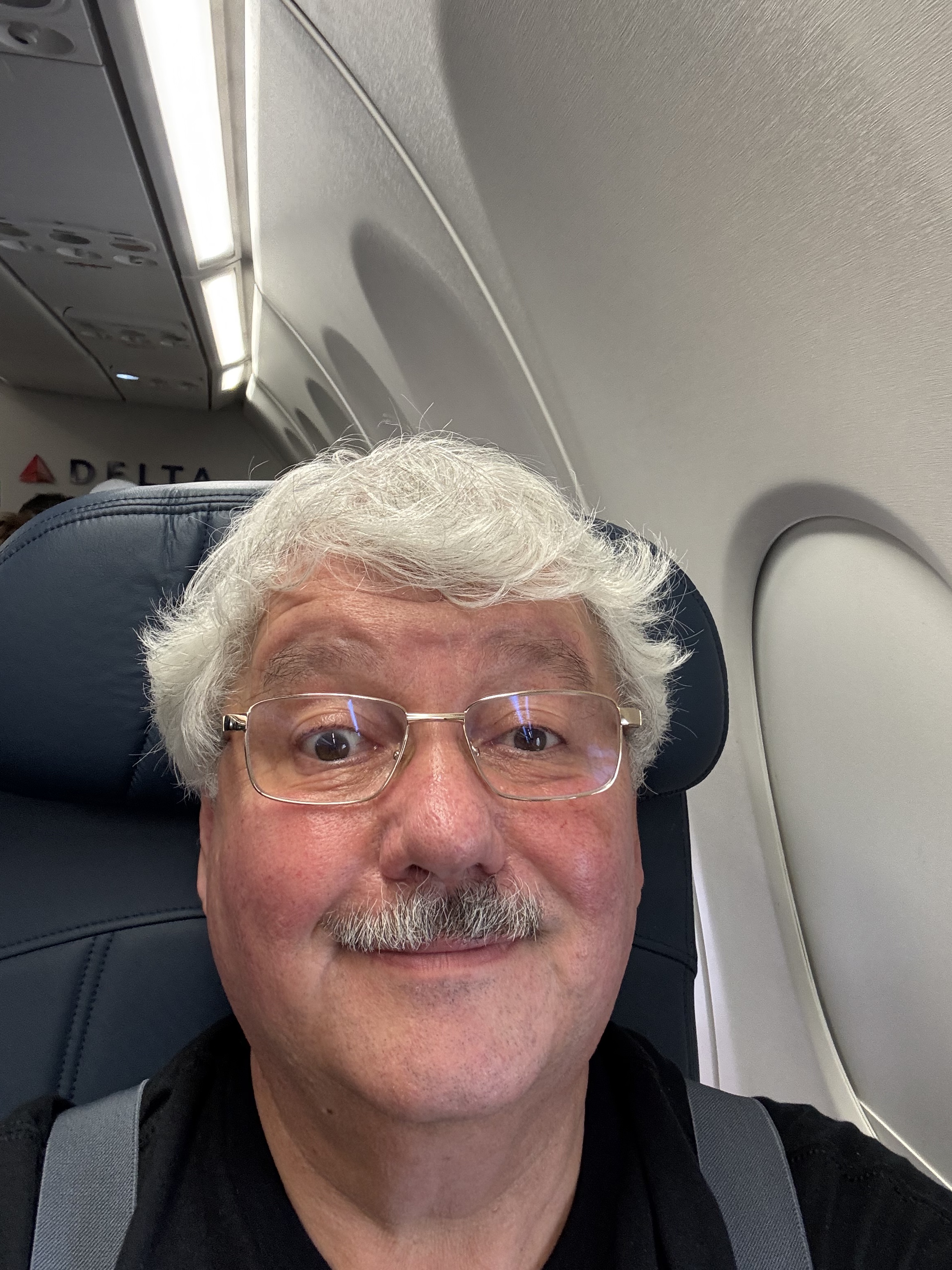
We would also spend another twenty minutes waiting for takeoff. I watched Hopper, a cute film from Pixar. I finished half of it on the ground. I found myself seated next to Rosie, whom I saw but did not meet at Hope 2026, is a director in the 44net community (covering Ham radio) and resides in the Portland area. We chatted and talked about the convention and were happy that nobody took the middle seat.

Corwin picked me up at the airport in Air VW the Gray and took me home. The house had been picked up and cleaned. The bed had been cleaned and was ready to use. I also uploaded yet another photo to Brazil, and we will see.

I was soon asleep. Thanks for reading.
Sunday Last Day Hope 2026

Again, I started at 6 and watched the sunrise light up NYC as I peeked out my window on the 33rd floor in The New Yorker while writing. I spent my first hours writing a blog about 2026 and my experiences in NYC. And while I was not rushing, I wanted to get breakfast and still be early to look around the vendor tables and villages at Hope 2026. I wrote with expediency.

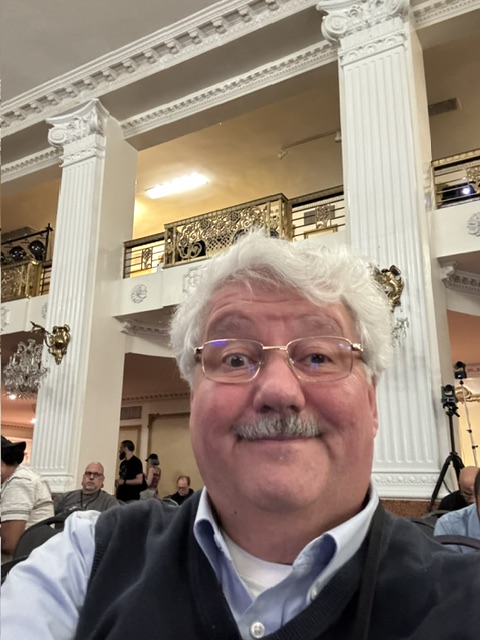
I decided on a dress shirt, a sweater vest, and dress shoes today. I always feel more comfortable dressed up. I noticed that I became more invisible because many hackers ignored me as part of the staff. Interesting.

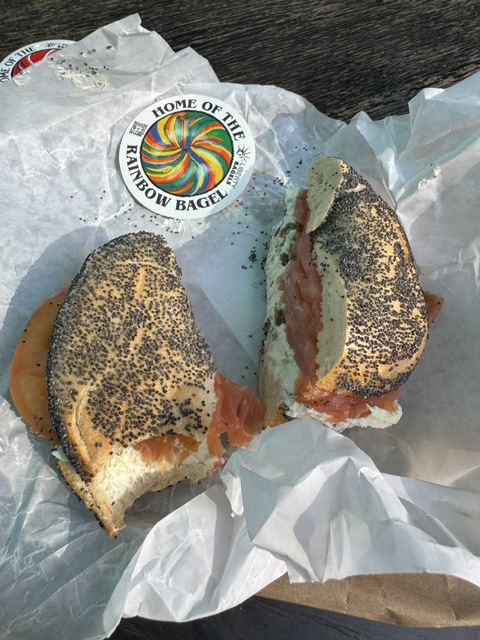
Again, though I thought of trying somewhere else, I went with Liberty Bagels and only switched from a poppy to an everything bagel. I ate again, sharing a table outside with a man from Mumbai, India, who was carrying his luggage. His accent sounded like he had been in the USA quite a while, and he shared that he works here. We talked about him getting presents for his sisters back in Mumbai from New York City. I suggested a postcard from NYC with cash paper-clipped to it, and called it “an American historical portrait” and a postcard. He liked the idea; we wished each other well after finishing and headed out. I saw him picking up his bags and carrying them into the subway.

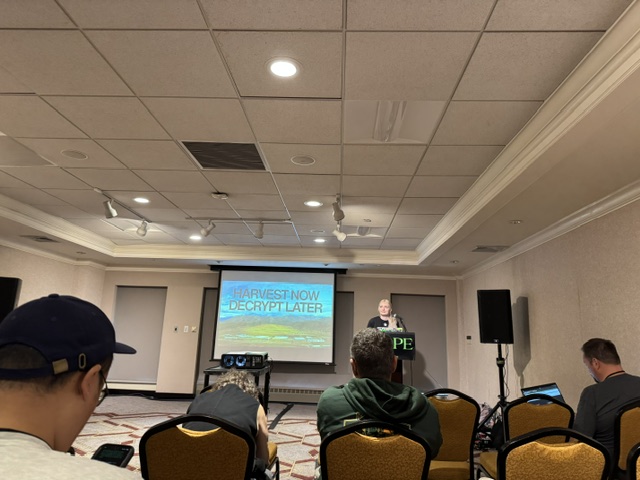
My first session was “Harvest Now, Decrypt Later” by redshiftzero. This was actually about the challenge of Quantum Computing breaking current encryption. Redshiftzero, a physicist, covered the main types of encryption used for traffic and explained that it will be broken if Shor’s Algorithm can be reliably used on a Quantum Computer. The physicist then noted that, in March, Google reported success in breaking some encryption and is now working on the next step to bring this technology to fruition. This paper has been peer-reviewed, and most believe it shows real progress; the paper did not release the circuit (the name for the weird coding/pricess of running stuff on quantum computers. Instead, another related problem was presented that is solvable; it would imply that encryption could be broken. Oddly, the presenter shared that there is a website contest to improve the circuit, with many creating better runtimes.

The presentation then focused on the state of the change to post-quantum computers and hardened encryption based on unsolvable lattice and other mathematical problems. President Trump has issued an executive order ordering the Federal Government to move to these protections by 2030 and 2031.

Next, I listened to a panel discuss “The Adversary in Your Bed: Stalkware, Domestic Violence, and the Hacker Defense” by a group of NY prosecutors. The message was dark. The law is not keeping up, and judges do not understand technology and will not make adjustments for it. That until violence is provable, a person can get no legal protection from stalking and domestic violence in New York. The warning was that even after you do all the right things to remove tracking, a stalker will often also bug and track friends and family to get access to you. Kids’ toys with computers may be hacked into listening devices, mutual friends’ cars might have squares in them, and phones hacked to listen in.

“Non-Human Identity – The Gaping Security Hole That Agents Are Making Worse!” by Michael Morgenstern was alarmist, but not an area I know well. He is a consultant and has discovered that AI tools and other software are being granted access via administrative users, creating easy hacking vectors. These non-human accounts are granted high-level access, and then AIs use them to create even more access. This then becomes a means to gain access for dark agents. Most attacks are moving from malware to exploits of these accounts.

“Honey Potting AI Agents” by Abdel Fane covered more of this. Fane set up honeypots to attract non-human agents to see how many were out there scanning. The MCPs (a type of AI agent) scanned his honeypots millions of times but did not try to take the bait; only a very few did. He concluded that most of the AI agents are not malicious but are studying the Internet. The presenter believes that the agent tool OpenClaw, available to anyone, has sent out many of these agents for various tasks.

I sat through two poorly done presentations. The presenters, I believe, did not understand that it was a presentation intended to inform and maybe inspire action. Instead, it seemed to be a brain dump.

Jamie Theophilos, a PhD candidate, is researching doxing and has covered the history of Doxing (or Doxxing), with information on over 1,000 incidents (there was a request for Jamie to share this in digital form, which Jamie said is now under discussion). The message was that both the left and right have used this as a punishment and often misidentify people and release harmful attacks on innocent folks. Jamie’s interest in doxing began when they were mistaken for someone else and doxed.

I could not understand much about 44net other than that it seems to be a Ham Radio version of the Internet from a talk by John Birwell: “Decentralized Networking Is A Social Problem.” There are nuggets there and a story.

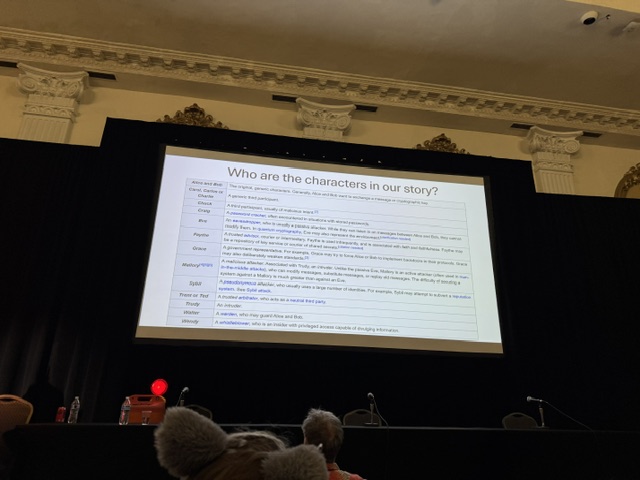
“We need to talk about Signal” by HelpMeRob was about Signal, a type of messaging software. The presenter ran out of time, but covered some flaws in the software, some surprising ones, and shared that WhatsApp and Google use the underlying Signal software. He tried to explain, I believe, that perfectly secure texting is not possible, but the user needs to decide what they require and accept the security compromises the software makes to provide the service.

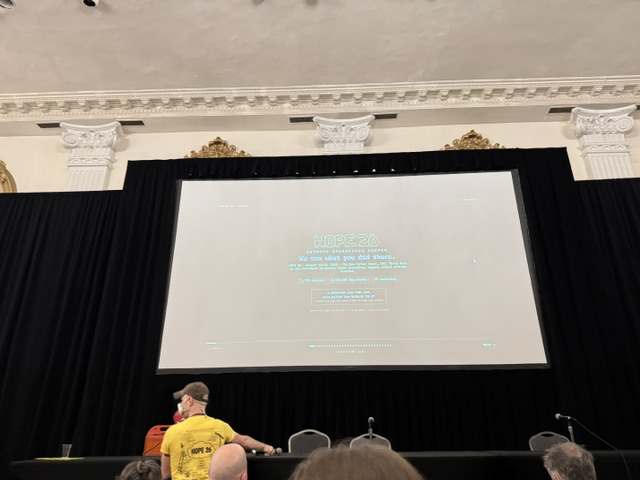
Dave, whom I met this year, sat with me for the closing ceremonies. The NOC (Network Operations Center) report was fun. The very secure network was fully protected this year from tens of thousands of attacks. And while it may seem counterintuitive for Hope 2026, they provided a complete log of every connected device, its location, and demoed it. They found one device that had hit 19 of the 20 WiFi connections, and then mapped its movements for the audience. There were many laughs as they played an animation of the device moving. Next, they mapped the device to exact presentations and events in Hope 2026. More laughs. And while you, dear reader, may find this strange, this is a hacker conference, and we know what is possible. But it was fun to see how easily we can be tracked. The motto of NOC, “We See What You Have Done.”

All the logs, along with software to process them, some preprocessed for faster access, are now available to everyone on the Hope 2026 website. And while this may seem strange again, it was a reminder to everyone of what is possible. The hackers were hacked at Hope 2026 by the friendly folks of NOC.

Aside: The NOC folks congratulated those who rotated the MAC address on their devices, making tracking more difficult. They, of course, identified most of them anyway. Fewer laughs! All the data is available for the hackers to explore how they were identified.

The final words and a conga line finished the conference. I did one loop with Dave and a person in powered scooter.

Dinner for me was at Lady Wilde’s down the street. I had a drink, nearly perfect lamb chops, and an OK dessert. I ordered No Starch Press’s book on Quantum Computing, recommended by redshiftzero, I spoke to her later, and she recommended that IBM is letting folks sometimes try a circuit on their computer. I looked at that website too. I loaded Rust on my Apple laptop.

Returning to the hotel after it rained, I revised my Rust setup, got it to a stable version, and partially used Visual Studio to write a “Hello World” program, then executed it from the command line. I will figure out how to get VS working for Rust later.

I went to bed a bit early and soon slept. Tomorrow is a travel day, but I still get part of the day in NYC.

Thanks for reading!


Saturday First Full Day Hope 2026

On Saturday, I spent most of my time listening to presentations at the New Yorker Hotel in NYC. I took notes with a pen and notebook during the lectures and photographed interesting slides. I do not bring my laptop to a Hacker’s Conference! I saw Bryce a lot, a person I met at the conference; he had volunteered for security work and was checking badges and being helpful as the need arose. There had been a call for volunteers, and some new folks were introducing speakers and the like.

I rose at 6 again, and, dearly missing a coffee maker in the room, or even a microwave to heat water for instant, wrote the blog for a couple of hours in my room. I shower when I’m about 80% done and finish it before breakfast. It was just over 2 1/2 hours of work. I then stash the laptop and head out with my badge on, my phone, an extra battery, a notepad, and a pen, in search of coffee and breakfast.

Today, I skipped the hotel Tick-Tock 24-hour diner and walked across the street to the insanely busy Liberty Bagels, home to the Rainbow Bagel (I had poppy). The line was long and the place packed enough to make you concerned, but there was a security person directing, and soon there was a line outside. I had made it just before it got even more crowded; it was already at my limit for situational awareness!

Despite the crowd, everyone seemed friendly and looking forward to coffee and bagels. Some folks were the get-food designees and were getting a large bag, but my single coffee and bagel reached me soon. Excellent. No outside food in the hotel conference rooms meant sharing a tiny round table outside at Liberty Bagels. Soon a gal from Maryland joined me, and then, the name eludes my memory, a man from the conference also joined in. We talked about Maryland, travel, and work. I was being my usual social butterfly, and they seemed to enjoy it.

I took the coffee with me and finished it at the conference. “Source Protection and Digital Security Techniques Under Surveillance” by Smitha Khorana was my first lecture, and it was less about techniques and more about repression and how Trump did not start this; rather, the repression of the press began under the Obama administration, according to the speaker. The first questionably legal revocation of passports was against Yemenis by Obama’s State Department. I was hoping for more how-to and QR codes to check sheets, but this was just slides. At some points in her lecture, she read them to us. A few folks walked out.

In the Grand Ballroom, Erica Windisch gave a talk on “The Onion Shell: Zero-Install Tor From the Browser.” Erica built this in response to a local school locking down and requiring kids to use Chromebooks at school. I know next to nothing about Tor file-sharing software and servers. I did learn that the two sets of servers, Snowflake 01 and 02, are vertically scaled access to Tor. Erica bemoaned, and there were supporting noises from the audience, that horizontal scaling would be better. My experience with servers at Nike in the computer department meant I understood the issues, and it was interesting to see this problem in another setting. Vertical scaling means, dear reader, you need bigger and bigger servers, while horizontal scaling means you need more and more servers, with some means to share the work, divide the workload, and manage related communications. Tor is streaming and sending data, which is hard to keep alive with various paths and very difficult to reassemble at the target; your computer playing a video, for example, in order when vertically split. Erica built a connection to Tor that installed nothing on your computer and required just your browser.

The software was done in Rust. This has shown up a few times in my lectures. I will have to take a look at Rust.

I crossed the hall to my next lecture. Bryce was there checking badges, and I walked into “A Practical Guide to Facial Recognition Evasion” with Prowex in makeup that appeared to obscure their identity and IQ Lens eyewear that, when scanned, blocked the view of your eyes, causing any ratio-based face recognition algorithm to be less accurate. Prowex discussed many ways to look different. I learned that trans folks learn a new voice, which is obvious, but I had not thought about it before. Gate identification is the new thing that is hard to stop. It is difficult to move differently. The other surprising idea was that you should not be a ghost or wear obvious makeup to block the cameras; this may get you spotted immediately and, even worse, remembered. Instead, be “gray”; you need to be seen as nothing interesting and only avoid or block when you need to. Being a ghost will make your appearances interesting.

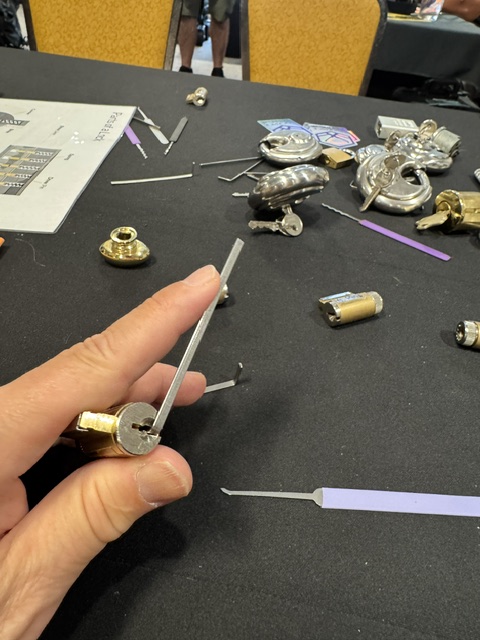
I had planned a class on lock picking, but I found a free spot at the lock-picking village (a kind of shared space for groups to hang out and do things), and there I got schooled on locks and how picking works. I listened as a visiting locksmith and my instructor from LockpickExtreme discussed techniques. LockpickExtreme expert sells lockpicks (only online this time, as NYC looks sideways at unlicensed purchases of lockpick equipment).

I managed to repeatedly get the easy lock with only two pins to open, my first lock picked, but I could not get the three-pin to open and soon headed to lunch. I would try again between lectures when one ended short, but did not manage it. Lunch was at the Taylors with the same bartender.

Rambo Anderson, the other speaker, has built a photo tool, Nullface.me, available online that uses known tracking algorithms to detect changes in your appearance. I tried it while they lectured. You take a starting look, and then it tracks the changes you make. I removed my glasses, made a face, and dropped my rating to 75%, matching the original. It stores no data and is not trained on images; thus, according to Rambo, it has no ethnic biases.

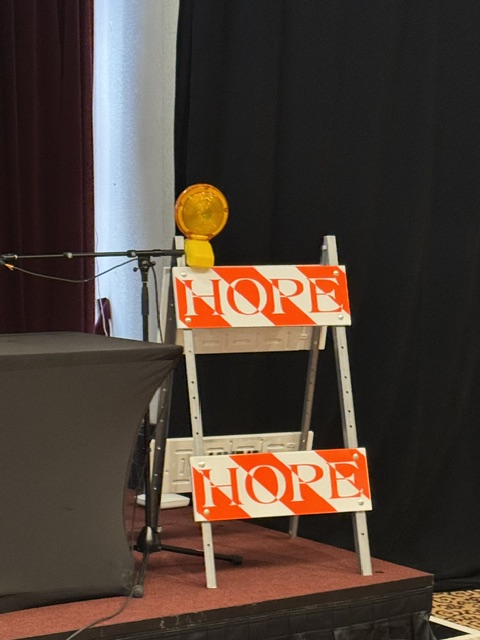
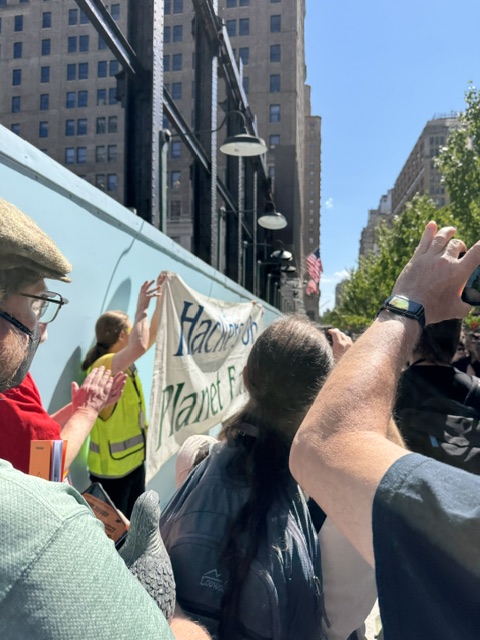
I joined the procession to the hole in the ground that was once the Penn Hotel and the site of the original Hope conferences. There were many words about hope and about remembering what Hope and hacking used to mean: “What happened to the Linux jokes?” It was fun, irreverent, and sad all at the same time. Others and I beat on the construction barrier and looked at the old metal beams still left, now, instead of holding up a hotel, supporting a huge screen filled with bright ads.

I met Gil at the next lecture, which he disliked: “The Art and Science of Metaware,” with Winn Schwarian talking about the problem that is making all of us insane, TMI (Too Much Information), and selling his book and his next book (which is what upset Gil). I was interested to hear that cognitive board games were a means of developing filters to ignore useless information, and that they needed help developing more games. Gil later told me that all this information, new to me, was dated and well understood. I said I thought it was a fun presentation; Winn was a fun speaker, and Gil admitted it was fun, well, sort of.

“Zines Against the Machine: Analog Communication for a Digital Dystopia” by Jack Gangi was upstairs in the Gramercy Park Conference Room. Gil sat next to me, and that is where we talked about the previous lecture. Jack Gangi was stressed, as Jack had accidentally doused his laptop with Red Bull just before Jack’s lecture and was challenged to give a talk. The laptop was able to display the slides, which were the first I saw at the conference that were not bare-minimum. I learned that a good way to get your Zine out is to trade it with others making Zines. He also recommends giving them to friends and folks you know, “Preaching to the choir,” or just handing them out and finding stores to have them on shelves, “Spreading the Good News.”

There were some folks from magazines, and they shared at an extended question time. Jack was done early, as he rushed after all the stress, he said. They said their magazine was not seeing increases in digital sales, but print sales were going up. That printed material is on the comeback. Jack pointed out that the end of comic books has been discussed for years, but now sales of physical material are rising.

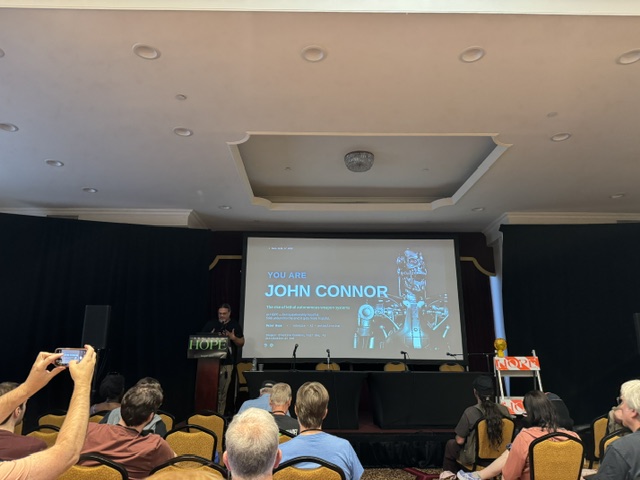
“You are John Connors: The Rise of Lethal Autonomous Weapon Systems” by a practitioner of robot development, Peter Haas. And while this was interesting, and I liked Peter’s words, “Terrifying does not describe it,” it seemed a bit alarmist. I did learn that China-based chips have quality issues and poor, if not nonexistent, documentation and testing. He described this, and it does fit some of my experiences: “Robots as Internet of Crap.” He believes that we all need to fight against allowing any autonomous weapons to be used on humans. Making this idea as unacceptable as the use of chemical weapons is now. “You are all John Connor.”

Gil had to be warned after getting into a heated argument at question time with folks about the approval process of drone strikes in the US military. I saw Gil here and there after that. I was not avoiding him, but not looking for him either.

Aside: John Connor is the kid in the movie who becomes the future leader against AI machines, the Terminators, or Skynet.

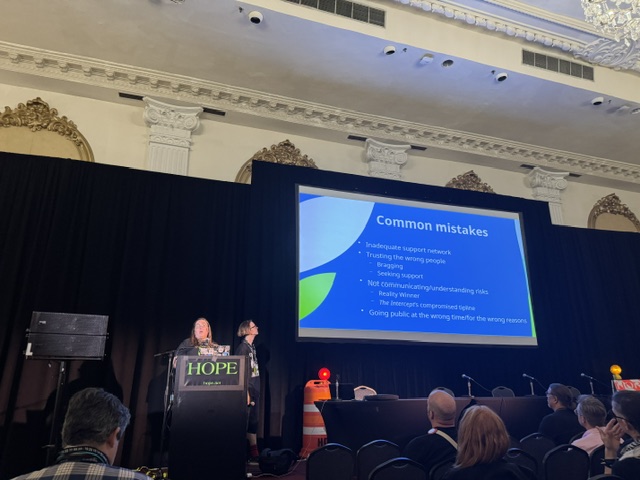
My last lecture, “How to Be a Whistleblower” by Emma Best, John Williams, and Jeremy Hammond, was another journalist-based discussion. The warning to Hope 2026 was that the costs of being a source are huge and unpredictable. Emma also shared that most leaks concern political power rather than morale issues. Emma next warned that the press, instead of doing the work to process and explain the material, will often take the cheaper, easier “hero or traitor” story about the person who leaked it. Being a source, they warned, is a choice with consequences, but still it is about doing the right thing.

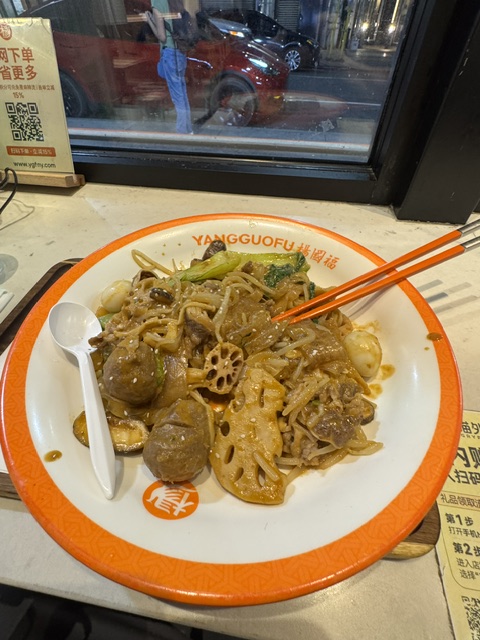
I parked my notebook in my room and then headed out to dinner. I found an Asian-style place we passed up when I had dinner with Kat. The name escapes me, but you assemble your food like a Mongolian Grill (not a grill), and then they make it dry or with broth. Sort of a Pho/Grill mix. It was a lot of food, but I mostly did veggies and went with dry. I shared a counter with a couple from Philadelphia down for the weekend.

I thought about going out for drinks and finding some hackers to hang out with, but instead returned to 3319. I visited the door of the Tesla Room again, around the hall from my room, smiled, and then went back to my room. I talked to Deborah for a while; we missed each other. We did a FaceTime call as we both cuddled up in our beds and said goodnight.

I soon fell asleep and did not wake until just before sunrise at 5-ish. I managed to roll over and sleep more. I likely dreamed of picking locks, keeping machines safe, and doing journalism in a dream world, but all I remember is that I dreamed.

Thanks for reading.
 

Friday Hope 2026 Day 1

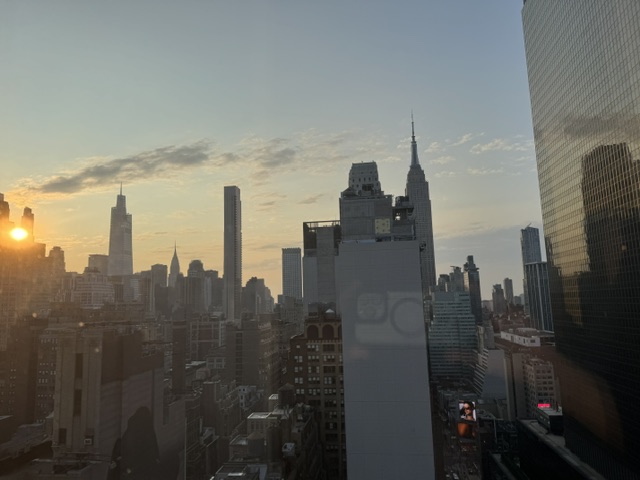
I rose again with the sunrise over NYC and looked out my window. I would, before I wrote a blog, shower, dress, and walk the city as it woke up to another day, but now I write and watch the colors change as Manhattan opens to another glorious sunrise in my room. The discipline of years of writing helps, but I still feel a call to the outside; today is an all-inside day. It is a Hacker’s Conference, and Hope 2026 is inside with pale computer SecOps folks.

The crowd is a mix of older people, many showing the effects of a life as a computer specialist, heavy, or young people showing a mixture of difficulty with social interactions, indeterminate gender, or an intensity of overcompensating for social difficulties. Hackers. Some will be looking intently at screens during talks, while others tap fast and take moments to work on something with complete attention.

The Opening Ceremonies for Hope 2026 are at 10:30, and my vouchers are done: I have to buy breakfast. I invested the first hours in writing and rushing. I am excited to start and also worried I will feel out of place. I am not a hacker or SecOps expert. Still, it is exciting, and I push out over a thousand words.

I talk to Deborah once I get started, and it is good to be in the same time zone. We will connect here and there between items. I also spoke with Dondrea about some church matters, and I am deeply disappointed by some findings that I will not describe here; I am not sure what my reaction should be. I try to keep my focus on the reason to be here: Hope 2026.

The opening ceremonies were more of a welcome and a celebration of being back in Manhattan. There are memories of people who have passed and how happy they are to make this work. Kyle, the network builder, says it was very difficult this time to get the powerful network function working, but it is now. Hope 2026 serves near-real-time remote content with huge volume needs. It fends off hacker attempts as a matter of pride. It is safe, maybe the safest, fast, and carefully monitored. The hardware, NOC (Network Operations Center), is here, not in the cloud, and resides on the Grand Ballroom balcony.

“Reclaiming the color orange,” explains the reflective safety orange as one of the themes. The construction theme is about reclaiming the narrative, rebuilding, and resisting the takeover of social media and the Internet by corporations, as well as the divisive speech I heard. “We don’t have to be that way; make it as comfortable for others as possible,” is scrawled in my notes. There is a reminder that smoking, vaping, and similar activities are forbidden in the hotel and that they have sensing equipment, they are told. There is a statement to leave that alone, respect the hotel, which has been great, and not defeat it. There are nervous laughs, like children reminded to play nice with others. And with that, the first sessions begin.

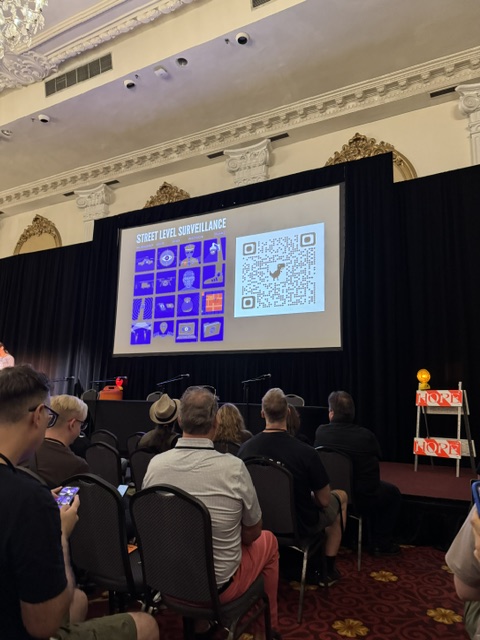
“Cameras, Cops, and Cell Towers: A Field Guide to Modern Surveillance” by Michael Raymond, whom I have heard before, starts my sessions also in the Grand Ballroom. He points out that the company Axon, formerly Taser, makes lots of the equipment. He also reminds us that many HOAs, stores, and law enforcement agencies have cameras and share the recordings. He was unable to defeat the face recognition with makeup or by wearing another tiny face on his glasses. He covers Flocking, and a Freedom of Information request, with proper understanding of what to request by doing research into what the local government is using for tracking, is the best way to check if your information is being checked.

Interestingly, the high-tech Stingrays, the name for fake cell towers that can easily track cell phones, are not in use as much as was thought, he reports. The hackers have a hardware box for spotting the fingerprints of a Stingray. He supplies, and I have photos of QR codes to help resist this surveillance.

The Flock cameras are given special attention. Flock cameras are, I learned, just a Raspberry Pi with a camera, powered by solar cells, and connected to Flock’s network. And while of questionable legality, he suggests that these devices are easy to cover, cut down, and make nonfunctional. He also points out that Axon now tracks Flock’s rejection of selling the same service using Axon equipment, which is less well known.

Flock also tracks bumper stickers and other vehicle markings, along with make, model, and color information. I share this information with friends who are facing harasment/stalking. Michael’s talk was worth the price of entry, I think.

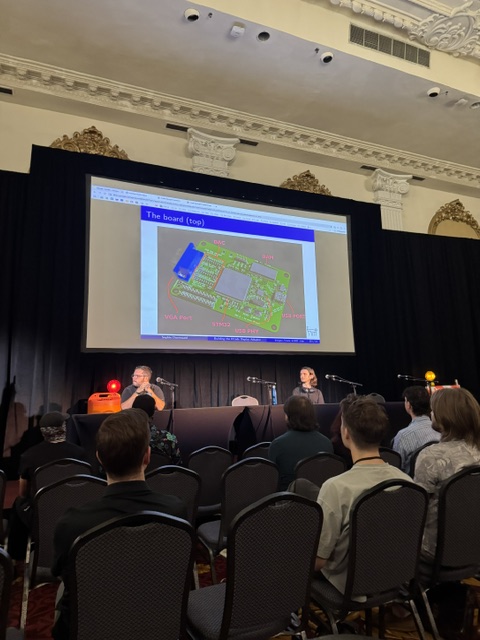
Next, “Building a Community Arcade Cabinet by Frank Chiarulli, Rose Hall, and Sophie Downward covers some of the details for bringing a video-tube arcade back to life. Sophie covers how they designed a USB-to-VGA conversion board, including surface-mount parts, to control the screen. A resistor was missed for a crystal-based timer, but Sophie tells the story of her putting her finger in, as the resistance of a human body was a close match, and suddenly everything worked. I and others I spoke to later want a copy of that board. Wow!

They used Rust for embedded work; I have looked at it before. Interesting. They also all met at a hacker space in Brooklyn that offered a six-week break from coding to explore and be imaginative.

I stepped out, as the hour-long sessions were less interesting, and headed a block away to the Irish bar Tailors, where I had lunch. I ordered an iced tea that turned out to be carbonated; the bartender took it back. “Yeah, it is terrible.” The Shepherd’s Pie was good, and I ate it quickly. I met another person from the conference from Washington, DC, who had just arrived by bus. Sticking out of their backpack was a plastic pigeon that apparently is a family thing and is carried all over the country. Today it is in NYC.

“Leaking & Investigating the Epstein Files” was the next surprising option. The session included two writers, the person who represents the secure validation and release of this information, and one remote “Kyrie” hacker who released the trove of Iranian hacks of Ehud Barak’s emails, which contained more Epstein information. The former prime minister of Israel had a business relationship with Epstein.

The hacker obtained the information, tried to sell it, and finally released it to Distributed Denial of Service’s Emma Best, who protected the information and the “Kyrie” and confirmed that it appeared to be real. It was released “to do the right thing,” and the hacker was given questions earlier, and the answers were read only during the session. It was pointed out that “Kyrie” could even be in the room.

Emmy Best said that, when asked what she was most disappointed by in this process, the lawyers giving advice in the emails on how to avoid trafficking charges by rerouting abuse to other places should have been at least disbarred but were not ever even charged. Hmmm.

The next session, “Seeing Inside the Mind of AI,” was not very good, and I will not cover it here. But I did get one good quote: “Good systems radiate information to use safely.” But the next one, “Spacesuits, Mars boots, and Vegan Roots in the Desert Regolith,” by Scott Beiban and Elizabeth Jane Cole, was fun, though they were late and took 10 minutes to set up. They are volunteers conducting space-analog research for EV suites on Mars. They told the story of their difficulties and how they built a suit that simulates some of the challenges (cooling is needed next time, they explained, as they boiled in the desert heat in the uncooled pressure suits). It was fascinating to hear about their somewhat madcap adventures testing and building the suits. They have designed a habitat for Mars and have named their venture: Offworld.Voyage. A vegan-only plan for Mars.

“Nikola Tesla’s Time at the New Yorker Hotel” by Jeffery Velez was next. I learned that Tesla lived on my floor, the 33rd, and that his room and place of death were across the hall. He spent the last five years quietly in room 3327 at the hotel (I am in 3319). Wizard is the book that is recommended. I also learned that Trump’s uncle reviewed Tesla’s notes after his death and that President Trump demolished the first building bearing a Tesla plaque.

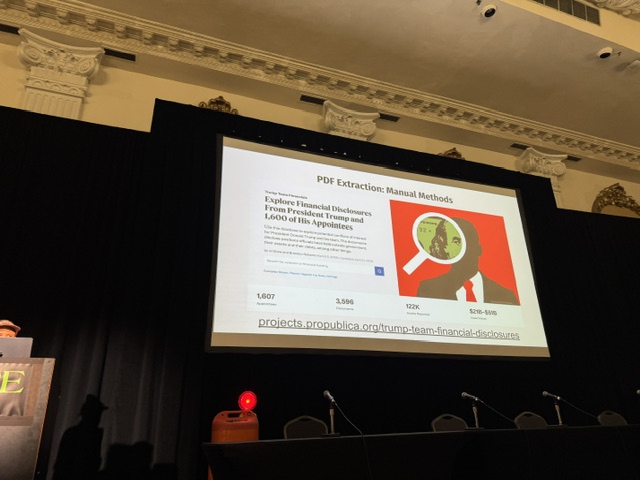
“Hackers: Journalism Needs Your Help” by Brandon Roberts of ProPublica was my last session on Friday. I was surprised to learn that there are tools to review government forms filled out by various officials and thus made available to journalists. I also learned that data cleaning and verification are a big part of the work now, and “bullet-proofing” findings from multiple sources is critical. They need updated tools and parsers to extract the relevant information (and what is missing). President Trump and Vance have provided their forms, but distorted the characters to make them hard to read with tools. They will need special OCR processes that are not available.

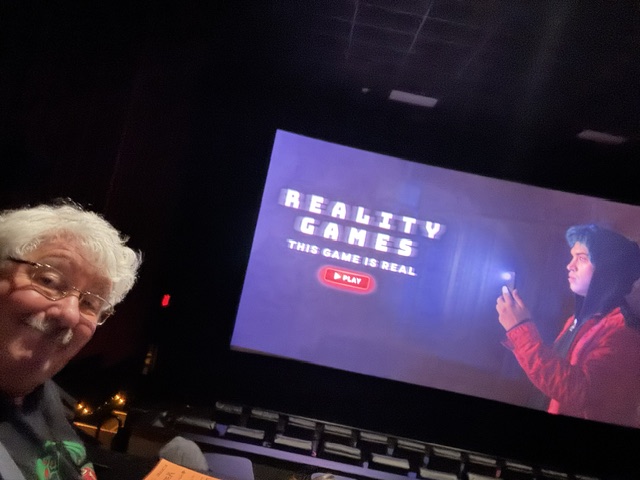
Lastly, I headed to the movie at the AMC theater across the street, Reality Games: Control the Narrative. It is a fun hacker movie about a fantasy of two young men finishing high school and then betting to “ruin their lives.” The movie is about a bet going wrong, shadowy organizations, and both believable and less believable hacks. It is a moral story where you find yourself, as the audience, cheering for the hero and then discovering the truth, feeling betrayed by the hero, and learning that social media and the act of cheering without enough information to make informed choices- real information, not clickbait- is the real problem. Interesting.

I talked to Kyle, our network builder for Hope, and he told me the story of how they finally got the Telcos to allow access to set up their closet. It was hugely stressful, and Kyle said he felt like he had grown up to managing relationships and reassuring people. No longer only tech stuff. The hotel management finally convinced the Telcos to work together. Kyle was happy to tell me his story.

After that, and more church stuff in my email, I headed back to my room, stopped by and looked at the door to the Tesla Room, and soon slept.

Thanks for reading.
 

Thursday Another Day Enjoying NYC

Thursday is my last full day before the conference, Hope 2026, at the New Yorker Hotel, starts. I rose, as usual when in this time zone, at 6 and watched the sun rise over NYC, with a view of the Empire State and Chrysler buildings from my single window in my room on the 33rd floor of the hotel.  I embrace jet lag and know that I am not here long enough to swing into the local time. I travel to the East often now and know what to expect.

I write the blog as my window shows NYC changing colors at sunrise. It was a busy day yesterday, and it took me a few hours to finish the story. It is August in NYC, and it is hot and sticky with travelers everywhere. My hotel is full of folks who, in the heat, show that less clothing is more. This is not Oregon T-shirts and come-as-you-are, but careful summer fashions that better fit The Devil Wears Prada in August NYC heat.

That is, until we computer people showed up with dark, weird T-shirts and mismatched, non-fashion shorts. And many of us Hope 2026 folks look uneasy in social settings. Nobody owns the room when they walk in.

I finish the blog as it gets near 9, get a shower, and pick another UFO Festival shirt (which also gets lots of comments like yesterday) to wear. I take my voucher and have another coffee, juice, and a bagel for breakfast at Tick-Tock, the 24-hour diner off the lobby. From there, I head back into the city.

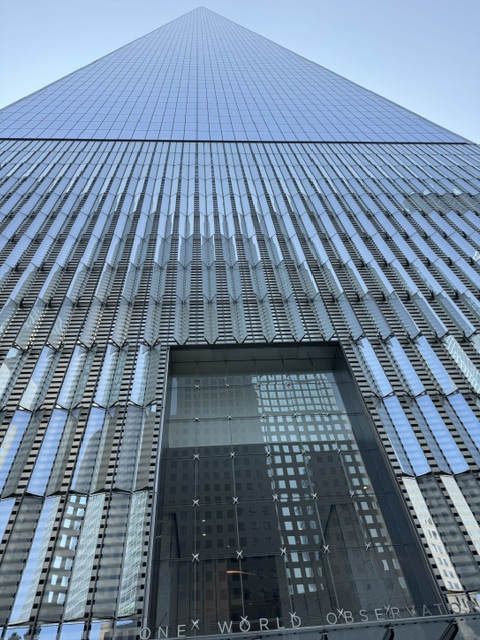
There is a subway entrance for the E train against the hotel, and I climb down the steps, scan my phone to pay the $3 fee, and find my way to the correct platform to head downtown to the World Trade Center. I have more than an hour before my VIP ($85) access to the One World Observatory. I walk to the footprint of the lost towers, and sadness is nearly overwhelming. For me now, Death is serious business, and while I did not know anyone who died on September 11th, I know people whose bosses died on the Boston-headed flight. Still, the space has become more of a park than a memorial, and I like the change.

I tried the Oculus building and walked through the mall inside, enjoying taking my time and following signs to locate my tour, which starts locally. The building is white and seems pure. It seems to say it is OK now, and the space has been reclaimed for the future. Enjoy! I walked it twice after checking in for my tour and was told to return before my tour. I also walk the park outside.

I get some coffee after seeing the river, then connect to another mall via an underground passage. It is a pleasant long walk. Ryan is our tour leader, and there are just three of us. A young California gal with her cousin or brother from Utah. The kid would be nearly bored to death. Ryan covers the tower construction, and soon we are in the “fastest elevator in NYC,” with the kid discovering that it is hard, nearly impossible, to jump in the speeding elevator. Its walls are a movie of the city’s growth.

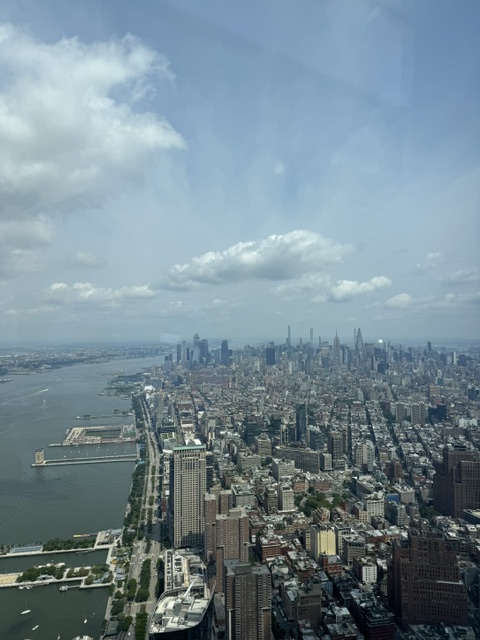
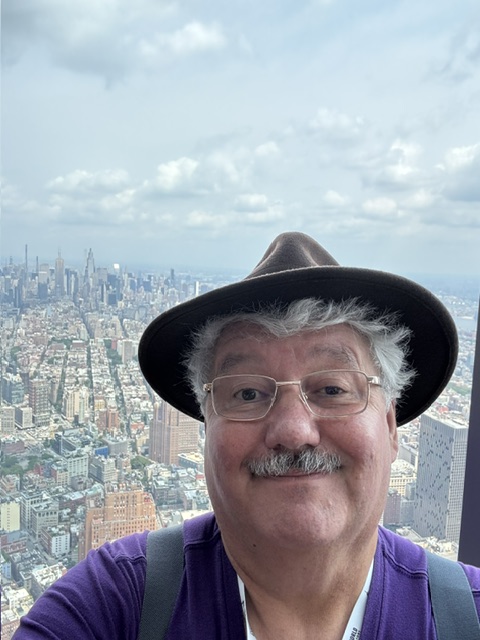
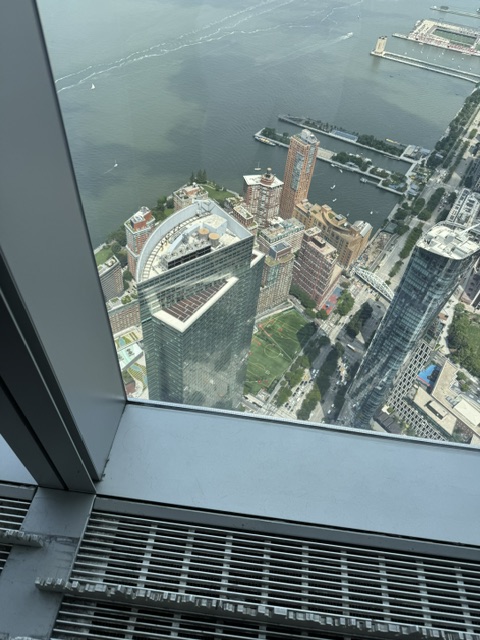
The view is 360 on the 101st floor with huge, clean windows. No outside here. I think the view is better from the Empire State Building’s outdoor observation deck (and the extra cost for spire access is about the same). Still, it is impressive, and I enjoy Ryan pointing out various buildings, including the Leaning Building, now dressed in graffiti at the top. I read more about it (leaning now, reportedly a full foot, and facing demolition).

I have $15 to spend, and my $30 lunch of grab-and-go and stand-and-eat tables has a view of New Jersey. I would have preferred Manhattan. The restaurant with coffee tables and chairs does not open until 2. There is no chandelier to show the building swaying with free drinks when it tilts far; at least that is my memory of the bar at the top of the lost towers, which I never visited. Ryan said this new tower only sways a few inches.

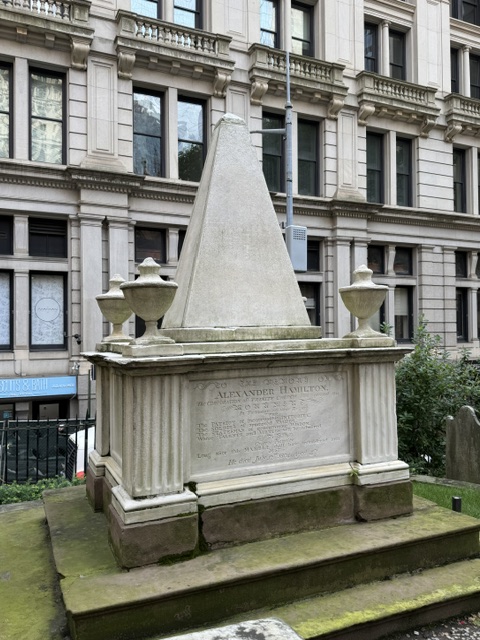
WTC2 has started, and a new huge tower will be finished in the 2030s. It is just a single story of cement base now. Ryan had pictures and pointed out Trinity Church, which will not be visible soon, as the new tower will be just below the eye line of this observatory. Ryan tells us about the two churches visible and mentions that Alexander Hamilton is buried at Trinity. I decide to visit Mr. Hamilton. I tip Ryan with a portrait of Alexander.

Pencils at the Observatory are less than $1 each, but the T-shirt is not cheap. The salesperson asks me if I have my voucher left, and I tell her, “Oh, I ate that,” which gets a laugh. I tell her that pencils at the Ronald Reagan Presidential Library cost $1.50 and that they should raise their prices. More laughs. I find my way to the restroom and think about how far that has to go while I complete that process.

The elevator screens are a flyover, and I have to grab the walls as the strange flying feeling in that fast elevator (41 seconds to travel 1,700+ feet down) makes me stumble. Wow! I wanted to take that again!

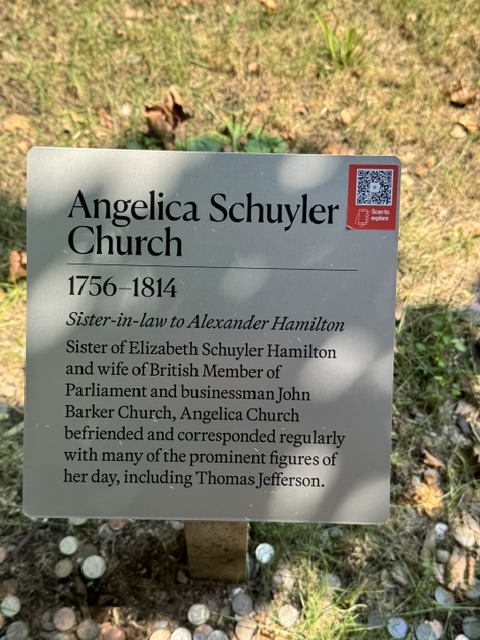
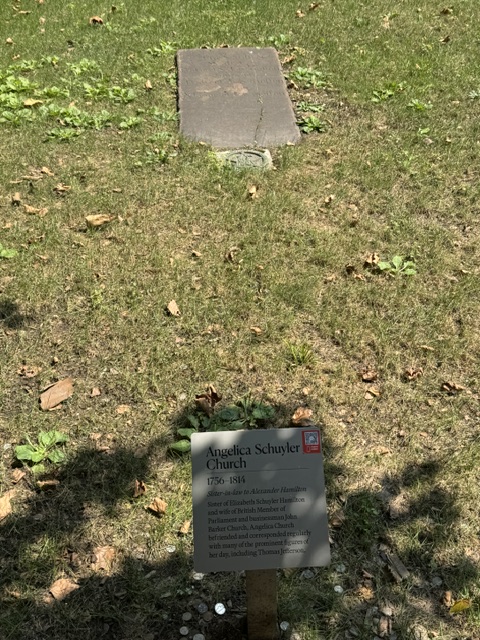
I walk the three blocks to Trinity. I find my way into the graveyard and can’t find Alexander. I talk to a friendly docent who points out that Alexander’s wife’s sister (one of the Schuyler sisters) has a simple stone. “You would think she deserves something better,” the docent shares.  I walk out as directed, pass the church entrance, see there is a line, and walk into the other graveyard. There I find the grave and some others. His wife, Eliza, another Schuyler sister, outlived Alexander Hamilton and spent her years helping people and even getting the Washington Monument (she knew the man) finished; she is buried with him, along with some of his sons. After the musical and all the reading I have done, it was nice to finally get a bit closer to Hamilton.

Wall Street begins at Trinity Church, and I walked past the NYSE and, as Deborah said, waved to our money. It was 3-ish now, and I took the 4 train back to the hotel. I then showered and rested for a few hours. I then headed to the second floor, got my badge for Hope 2026, and met a few people I remember. Frank had a working gaming console; he is from a local hacker space (they actually rolled the machine onto the subway). He and others had learned electronics and then built a coding framework to build games. They are hopeful of finding some graybeards to port some old games to their platform, or find some new coders who want to try it out. Frank opened the back and showed us how they created a USB-to-VGA converter. It was surface-mount, too.

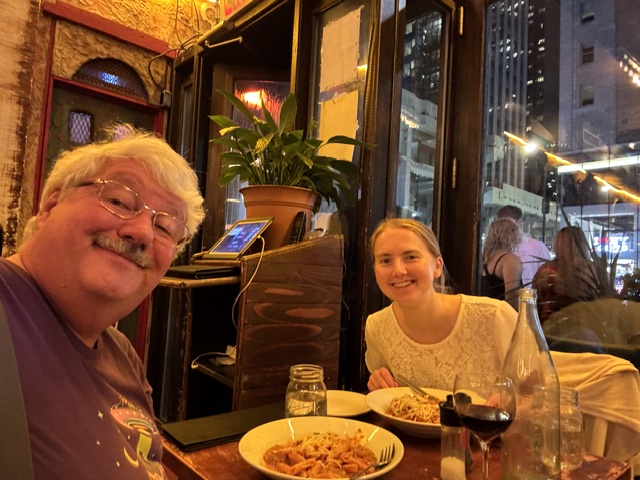
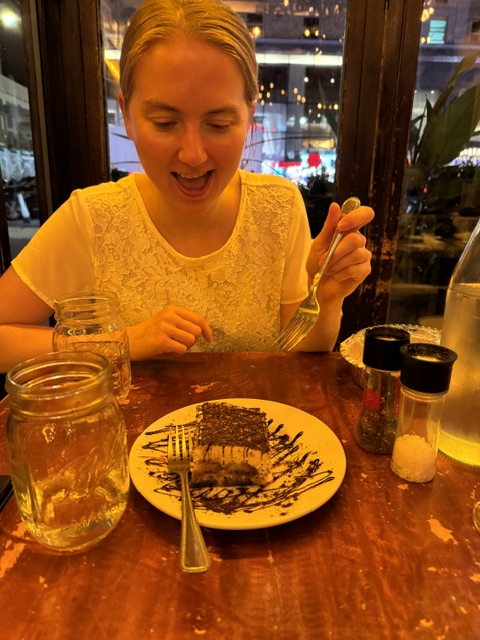
I stayed in the lobby and chatted with a few folks here and there, a few I remembered or remembered me. Kat was there at 7:30, and I had an idea for dinner. We walked ten blocks to El Forno: Hell’s Kitchen (though it is not really there, as that is four or five blocks away). I wanted Italian, and Kat agreed. I had the fixed-price dinner and Kat had a pasta meal (she shared a taste of my salad and more than a taste of my dessert). Sam was our waiter and helped us pick out our items. All was great, and the taste was sort of smoky with a hint of spices.

With dinner mostly inside us (Kat took some home), we walked back to the hotel, and Kat then went off to catch her train and sent me a note that she was home. I returned to the 33rd-floor meeting, met more folks for the conference, and learned that the party at the Irish place was good. I had skipped it to see Kat. Kat is available this weekend, but I am busy into the evening each day. We might connect on Sunday, or if I feel I need a break and she is free.

BTW: Kat works for Buck and enjoys her work. Her company is keeping up with AI trends, and she feels safe as both an artist and a technologist.

I was able to sleep well, woke just before sunrise, and managed to roll over again. It seemed to be a dreamless sleep. I was stiff from walking 5 miles and 7 miles the day before.

Thanks for reading!