On Saturday, I spent most of my time listening to presentations at the New Yorker Hotel in NYC. I took notes with a pen and notebook during the lectures and photographed interesting slides. I do not bring my laptop to a Hacker’s Conference! I saw Bryce a lot, a person I met at the conference; he had volunteered for security work and was checking badges and being helpful as the need arose. There had been a call for volunteers, and some new folks were introducing speakers and the like.
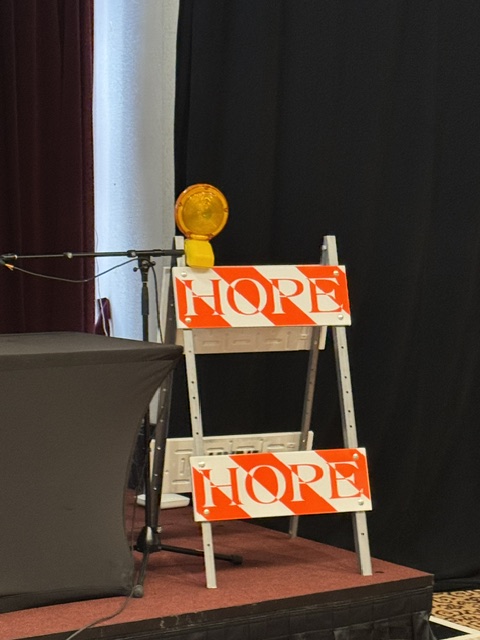
I rose at 6 again, and, dearly missing a coffee maker in the room, or even a microwave to heat water for instant, wrote the blog for a couple of hours in my room. I shower when I’m about 80% done and finish it before breakfast. It was just over 2 1/2 hours of work. I then stash the laptop and head out with my badge on, my phone, an extra battery, a notepad, and a pen, in search of coffee and breakfast.
Today, I skipped the hotel Tick-Tock 24-hour diner and walked across the street to the insanely busy Liberty Bagels, home to the Rainbow Bagel (I had poppy). The line was long and the place packed enough to make you concerned, but there was a security person directing, and soon there was a line outside. I had made it just before it got even more crowded; it was already at my limit for situational awareness!
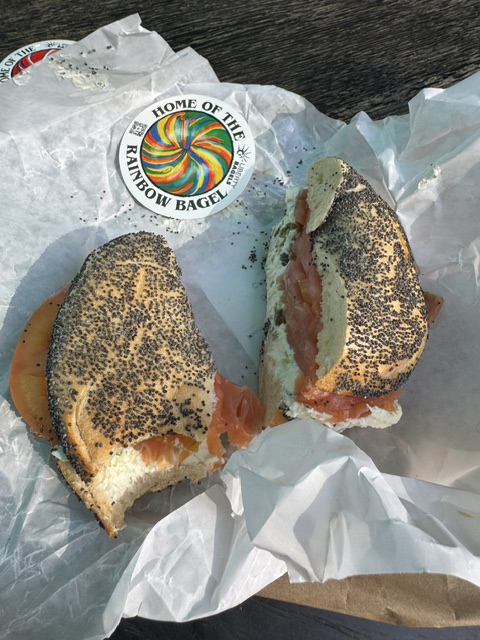
Despite the crowd, everyone seemed friendly and looking forward to coffee and bagels. Some folks were the get-food designees and were getting a large bag, but my single coffee and bagel reached me soon. Excellent. No outside food in the hotel conference rooms meant sharing a tiny round table outside at Liberty Bagels. Soon a gal from Maryland joined me, and then, the name eludes my memory, a man from the conference also joined in. We talked about Maryland, travel, and work. I was being my usual social butterfly, and they seemed to enjoy it.
I took the coffee with me and finished it at the conference. “Source Protection and Digital Security Techniques Under Surveillance” by Smitha Khorana was my first lecture, and it was less about techniques and more about repression and how Trump did not start this; rather, the repression of the press began under the Obama administration, according to the speaker. The first questionably legal revocation of passports was against Yemenis by Obama’s State Department. I was hoping for more how-to and QR codes to check sheets, but this was just slides. At some points in her lecture, she read them to us. A few folks walked out.
In the Grand Ballroom, Erica Windisch gave a talk on “The Onion Shell: Zero-Install Tor From the Browser.” Erica built this in response to a local school locking down and requiring kids to use Chromebooks at school. I know next to nothing about Tor file-sharing software and servers. I did learn that the two sets of servers, Snowflake 01 and 02, are vertically scaled access to Tor. Erica bemoaned, and there were supporting noises from the audience, that horizontal scaling would be better. My experience with servers at Nike in the computer department meant I understood the issues, and it was interesting to see this problem in another setting. Vertical scaling means, dear reader, you need bigger and bigger servers, while horizontal scaling means you need more and more servers, with some means to share the work, divide the workload, and manage related communications. Tor is streaming and sending data, which is hard to keep alive with various paths and very difficult to reassemble at the target; your computer playing a video, for example, in order when vertically split. Erica built a connection to Tor that installed nothing on your computer and required just your browser.
The software was done in Rust. This has shown up a few times in my lectures. I will have to take a look at Rust.
I crossed the hall to my next lecture. Bryce was there checking badges, and I walked into “A Practical Guide to Facial Recognition Evasion” with Prowex in makeup that appeared to obscure their identity and IQ Lens eyewear that, when scanned, blocked the view of your eyes, causing any ratio-based face recognition algorithm to be less accurate. Prowex discussed many ways to look different. I learned that trans folks learn a new voice, which is obvious, but I had not thought about it before. Gate identification is the new thing that is hard to stop. It is difficult to move differently. The other surprising idea was that you should not be a ghost or wear obvious makeup to block the cameras; this may get you spotted immediately and, even worse, remembered. Instead, be “gray”; you need to be seen as nothing interesting and only avoid or block when you need to. Being a ghost will make your appearances interesting.
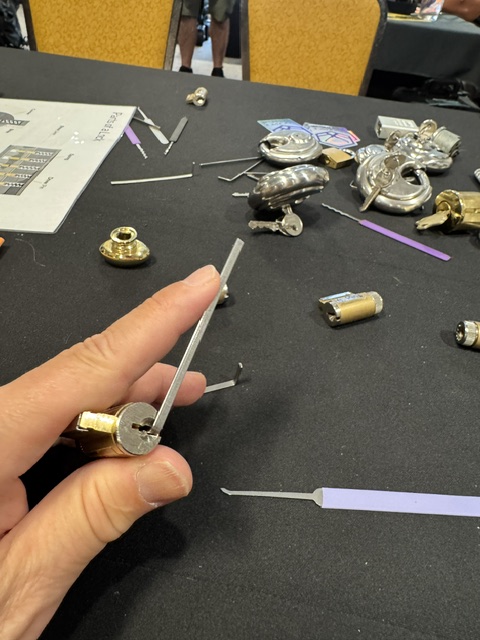
I had planned a class on lock picking, but I found a free spot at the lock-picking village (a kind of shared space for groups to hang out and do things), and there I got schooled on locks and how picking works. I listened as a visiting locksmith and my instructor from LockpickExtreme discussed techniques. LockpickExtreme expert sells lockpicks (only online this time, as NYC looks sideways at unlicensed purchases of lockpick equipment).
I managed to repeatedly get the easy lock with only two pins to open, my first lock picked, but I could not get the three-pin to open and soon headed to lunch. I would try again between lectures when one ended short, but did not manage it. Lunch was at the Taylors with the same bartender.
Rambo Anderson, the other speaker, has built a photo tool, Nullface.me, available online that uses known tracking algorithms to detect changes in your appearance. I tried it while they lectured. You take a starting look, and then it tracks the changes you make. I removed my glasses, made a face, and dropped my rating to 75%, matching the original. It stores no data and is not trained on images; thus, according to Rambo, it has no ethnic biases.
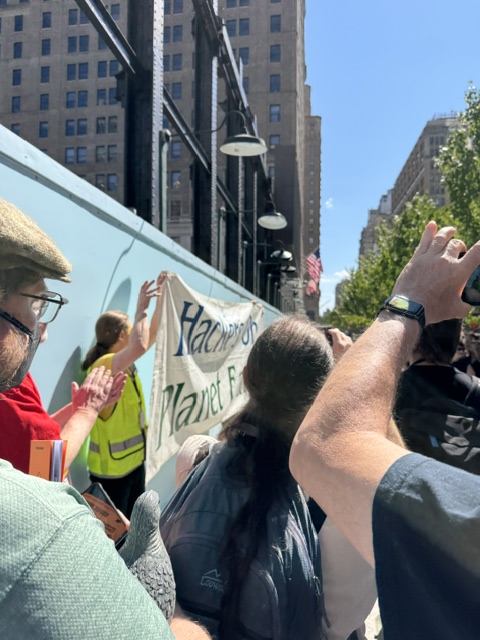
I joined the procession to the hole in the ground that was once the Penn Hotel and the site of the original Hope conferences. There were many words about hope and about remembering what Hope and hacking used to mean: “What happened to the Linux jokes?” It was fun, irreverent, and sad all at the same time. Others and I beat on the construction barrier and looked at the old metal beams still left, now, instead of holding up a hotel, supporting a huge screen filled with bright ads.
I met Gil at the next lecture, which he disliked: “The Art and Science of Metaware,” with Winn Schwarian talking about the problem that is making all of us insane, TMI (Too Much Information), and selling his book and his next book (which is what upset Gil). I was interested to hear that cognitive board games were a means of developing filters to ignore useless information, and that they needed help developing more games. Gil later told me that all this information, new to me, was dated and well understood. I said I thought it was a fun presentation; Winn was a fun speaker, and Gil admitted it was fun, well, sort of.
“Zines Against the Machine: Analog Communication for a Digital Dystopia” by Jack Gangi was upstairs in the Gramercy Park Conference Room. Gil sat next to me, and that is where we talked about the previous lecture. Jack Gangi was stressed, as Jack had accidentally doused his laptop with Red Bull just before Jack’s lecture and was challenged to give a talk. The laptop was able to display the slides, which were the first I saw at the conference that were not bare-minimum. I learned that a good way to get your Zine out is to trade it with others making Zines. He also recommends giving them to friends and folks you know, “Preaching to the choir,” or just handing them out and finding stores to have them on shelves, “Spreading the Good News.”
There were some folks from magazines, and they shared at an extended question time. Jack was done early, as he rushed after all the stress, he said. They said their magazine was not seeing increases in digital sales, but print sales were going up. That printed material is on the comeback. Jack pointed out that the end of comic books has been discussed for years, but now sales of physical material are rising.
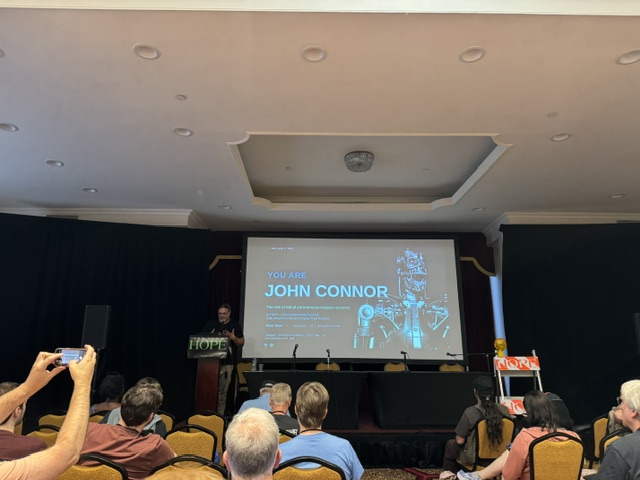
“You are John Connors: The Rise of Lethal Autonomous Weapon Systems” by a practitioner of robot development, Peter Haas. And while this was interesting, and I liked Peter’s words, “Terrifying does not describe it,” it seemed a bit alarmist. I did learn that China-based chips have quality issues and poor, if not nonexistent, documentation and testing. He described this, and it does fit some of my experiences: “Robots as Internet of Crap.” He believes that we all need to fight against allowing any autonomous weapons to be used on humans. Making this idea as unacceptable as the use of chemical weapons is now. “You are all John Connor.”
Gil had to be warned after getting into a heated argument at question time with folks about the approval process of drone strikes in the US military. I saw Gil here and there after that. I was not avoiding him, but not looking for him either.
Aside: John Connor is the kid in the movie who becomes the future leader against AI machines, the Terminators, or Skynet.
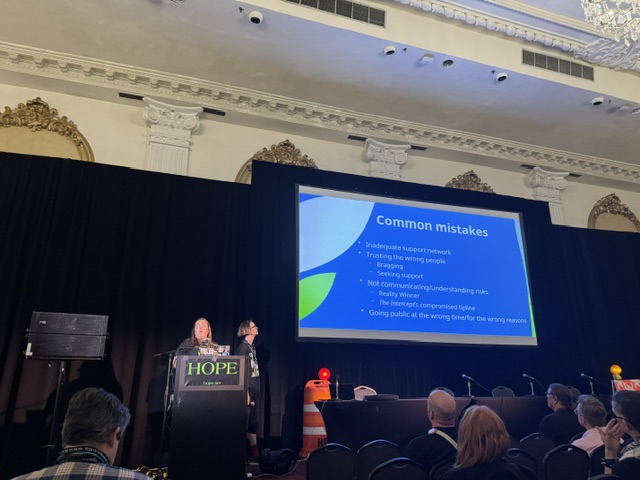
My last lecture, “How to Be a Whistleblower” by Emma Best, John Williams, and Jeremy Hammond, was another journalist-based discussion. The warning to Hope 2026 was that the costs of being a source are huge and unpredictable. Emma also shared that most leaks concern political power rather than morale issues. Emma next warned that the press, instead of doing the work to process and explain the material, will often take the cheaper, easier “hero or traitor” story about the person who leaked it. Being a source, they warned, is a choice with consequences, but still it is about doing the right thing.
I parked my notebook in my room and then headed out to dinner. I found an Asian-style place we passed up when I had dinner with Kat. The name escapes me, but you assemble your food like a Mongolian Grill (not a grill), and then they make it dry or with broth. Sort of a Pho/Grill mix. It was a lot of food, but I mostly did veggies and went with dry. I shared a counter with a couple from Philadelphia down for the weekend.

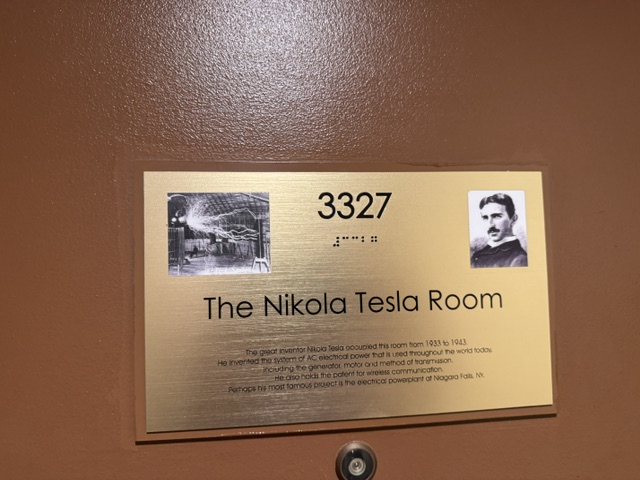
I thought about going out for drinks and finding some hackers to hang out with, but instead returned to 3319. I visited the door of the Tesla Room again, around the hall from my room, smiled, and then went back to my room. I talked to Deborah for a while; we missed each other. We did a FaceTime call as we both cuddled up in our beds and said goodnight.
I soon fell asleep and did not wake until just before sunrise at 5-ish. I managed to roll over and sleep more. I likely dreamed of picking locks, keeping machines safe, and doing journalism in a dream world, but all I remember is that I dreamed.
Thanks for reading.

 Alohawild (Michael Wild's) Website
Great information! I now know more about things I didn’t know I wanted to know about.
LikeLike